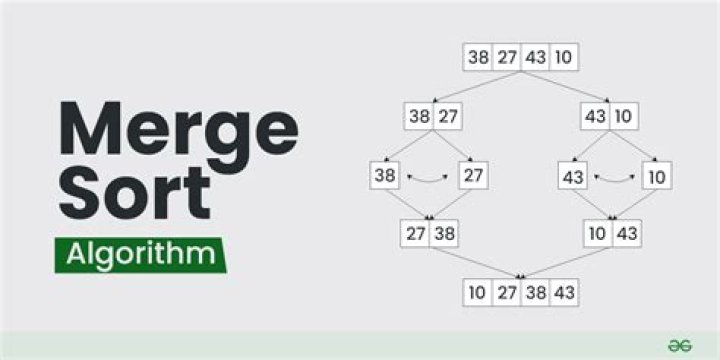

I couldn't find any working Python 3.3 mergesort algorithm codes, so I made one myself. Is there any way to speed it up? It sorts 20,000 numbers in about 0.3-0.5 seconds
def msort(x): result = [] if len(x) < 2: return x mid = int(len(x)/2) y = msort(x[:mid]) z = msort(x[mid:]) while (len(y) > 0) or (len(z) > 0): if len(y) > 0 and len(z) > 0: if y[0] > z[0]: result.append(z[0]) z.pop(0) else: result.append(y[0]) y.pop(0) elif len(z) > 0: for i in z: result.append(i) z.pop(0) else: for i in y: result.append(i) y.pop(0) return result 31 Answers
The first improvement would be to simplify the three cases in the main loop: Rather than iterating while some of the sequence has elements, iterate while both sequences have elements. When leaving the loop, one of them will be empty, we don't know which, but we don't care: We append them at the end of the result.
def msort2(x): if len(x) < 2: return x result = [] # moved! mid = int(len(x) / 2) y = msort2(x[:mid]) z = msort2(x[mid:]) while (len(y) > 0) and (len(z) > 0): if y[0] > z[0]: result.append(z[0]) z.pop(0) else: result.append(y[0]) y.pop(0) result += y result += z return result The second optimization is to avoid popping the elements. Rather, have two indices:
def msort3(x): if len(x) < 2: return x result = [] mid = int(len(x) / 2) y = msort3(x[:mid]) z = msort3(x[mid:]) i = 0 j = 0 while i < len(y) and j < len(z): if y[i] > z[j]: result.append(z[j]) j += 1 else: result.append(y[i]) i += 1 result += y[i:] result += z[j:] return result A final improvement consists in using a non recursive algorithm to sort short sequences. In this case I use the built-in sorted function and use it when the size of the input is less than 20:
def msort4(x): if len(x) < 20: return sorted(x) result = [] mid = int(len(x) / 2) y = msort4(x[:mid]) z = msort4(x[mid:]) i = 0 j = 0 while i < len(y) and j < len(z): if y[i] > z[j]: result.append(z[j]) j += 1 else: result.append(y[i]) i += 1 result += y[i:] result += z[j:] return result My measurements to sort a random list of 100000 integers are 2.46 seconds for the original version, 2.33 for msort2, 0.60 for msort3 and 0.40 for msort4. For reference, sorting all the list with sorted takes 0.03 seconds.
Code from MIT course. (with generic cooperator )
import operator def merge(left, right, compare): result = [] i, j = 0, 0 while i < len(left) and j < len(right): if compare(left[i], right[j]): result.append(left[i]) i += 1 else: result.append(right[j]) j += 1 while i < len(left): result.append(left[i]) i += 1 while j < len(right): result.append(right[j]) j += 1 return result def mergeSort(L, compare=operator.lt): if len(L) < 2: return L[:] else: middle = int(len(L) / 2) left = mergeSort(L[:middle], compare) right = mergeSort(L[middle:], compare) return merge(left, right, compare) def merge_sort(x): if len(x) < 2:return x result,mid = [],int(len(x)/2) y = merge_sort(x[:mid]) z = merge_sort(x[mid:]) while (len(y) > 0) and (len(z) > 0): if y[0] > z[0]:result.append(z.pop(0)) else:result.append(y.pop(0)) result.extend(y+z) return result You can initialise the whole result list in the top level call to mergesort:
result = [0]*len(x) # replace 0 with a suitable default element if necessary. # or just copy x (result = x[:]) Then for the recursive calls you can use a helper function to which you pass not sublists, but indices into x. And the bottom level calls read their values from x and write into result directly.
That way you can avoid all that poping and appending which should improve performance.
Take my implementation
def merge_sort(sequence): """ Sequence of numbers is taken as input, and is split into two halves, following which they are recursively sorted. """ if len(sequence) < 2: return sequence mid = len(sequence) // 2 # note: 7//2 = 3, whereas 7/2 = 3.5 left_sequence = merge_sort(sequence[:mid]) right_sequence = merge_sort(sequence[mid:]) return merge(left_sequence, right_sequence) def merge(left, right): """ Traverse both sorted sub-arrays (left and right), and populate the result array """ result = [] i = j = 0 while i < len(left) and j < len(right): if left[i] < right[j]: result.append(left[i]) i += 1 else: result.append(right[j]) j += 1 result += left[i:] result += right[j:] return result # Print the sorted list. print(merge_sort([5, 2, 6, 8, 5, 8, 1])) As already said, l.pop(0) is a O(len(l)) operation and must be avoided, the above msort function is O(n**2). If efficiency matter, indexing is better but have cost too. The for x in l is faster but not easy to implement for mergesort : iter can be used instead here. Finally, checking i < len(l) is made twice because tested again when accessing the element : the exception mechanism (try except) is better and give a last improvement of 30% .
def msort(l): if len(l)>1: t=len(l)//2 it1=iter(msort(l[:t]));x1=next(it1) it2=iter(msort(l[t:]));x2=next(it2) l=[] try: while True: if x1<=x2: l.append(x1);x1=next(it1) else : l.append(x2);x2=next(it2) except: if x1<=x2: l.append(x2);l.extend(it2) else: l.append(x1);l.extend(it1) return l Loops like this can probably be speeded up:
for i in z: result.append(i) z.pop(0) Instead, simply do this:
result.extend(z) Note that there is no need to clean the contents of z because you won't use it anyway.
A longer one that counts inversions and adheres to the sorted interface. It's trivial to modify this to make it a method of an object that sorts in place.
import operator class MergeSorted: def __init__(self): self.inversions = 0 def __call__(self, l, key=None, reverse=False): self.inversions = 0 if key is None: self.key = lambda x: x else: self.key = key if reverse: self.compare = operator.gt else: self.compare = operator.lt dest = list(l) working = [0] * len(l) self.inversions = self._merge_sort(dest, working, 0, len(dest)) return dest def _merge_sort(self, dest, working, low, high): if low < high - 1: mid = (low + high) // 2 x = self._merge_sort(dest, working, low, mid) y = self._merge_sort(dest, working, mid, high) z = self._merge(dest, working, low, mid, high) return (x + y + z) else: return 0 def _merge(self, dest, working, low, mid, high): i = 0 j = 0 inversions = 0 while (low + i < mid) and (mid + j < high): if self.compare(self.key(dest[low + i]), self.key(dest[mid + j])): working[low + i + j] = dest[low + i] i += 1 else: working[low + i + j] = dest[mid + j] inversions += (mid - (low + i)) j += 1 while low + i < mid: working[low + i + j] = dest[low + i] i += 1 while mid + j < high: working[low + i + j] = dest[mid + j] j += 1 for k in range(low, high): dest[k] = working[k] return inversions msorted = MergeSorted() Uses
>>> l = [5, 2, 3, 1, 4] >>> s = msorted(l) >>> s [1, 2, 3, 4, 5] >>> msorted.inversions 6 >>> l = ['e', 'b', 'c', 'a', 'd'] >>> d = {'a': 10, ... 'b': 4, ... 'c': 2, ... 'd': 5, ... 'e': 9} >>> key = lambda x: d[x] >>> s = msorted(l, key=key) >>> s ['c', 'b', 'd', 'e', 'a'] >>> msorted.inversions 5 >>> l = [5, 2, 3, 1, 4] >>> s = msorted(l, reverse=True) >>> s [5, 4, 3, 2, 1] >>> msorted.inversions 4 >>> l = ['e', 'b', 'c', 'a', 'd'] >>> d = {'a': 10, ... 'b': 4, ... 'c': 2, ... 'd': 5, ... 'e': 9} >>> key = lambda x: d[x] >>> s = msorted(l, key=key, reverse=True) >>> s ['a', 'e', 'd', 'b', 'c'] >>> msorted.inversions 5 Here is the CLRS Implementation:
def merge(arr, p, q, r): n1 = q - p + 1 n2 = r - q right, left = [], [] for i in range(n1): left.append(arr[p + i]) for j in range(n2): right.append(arr[q + j + 1]) left.append(float('inf')) right.append(float('inf')) i = j = 0 for k in range(p, r + 1): if left[i] <= right[j]: arr[k] = left[i] i += 1 else: arr[k] = right[j] j += 1 def merge_sort(arr, p, r): if p < r: q = (p + r) // 2 merge_sort(arr, p, q) merge_sort(arr, q + 1, r) merge(arr, p, q, r) if __name__ == '__main__': test = [5, 2, 4, 7, 1, 3, 2, 6] merge_sort(test, 0, len(test) - 1) print test Result:
[1, 2, 2, 3, 4, 5, 6, 7] Many have answered this question correctly, this is just another solution (although my solution is very similar to Max Montana) but I have few differences for implementation:
let's review the general idea here before we get to the code:
- Divide the list into two roughly equal halves.
- Sort the left half.
- Sort the right half.
- Merge the two sorted halves into one sorted list.
here is the code (tested with python 3.7):
def merge(left,right): result=[] i,j=0,0 while i<len(left) and j<len(right): if left[i] < right[j]: result.append(left[i]) i+=1 else: result.append(right[j]) j+=1 result.extend(left[i:]) # since we want to add each element and not the object list result.extend(right[j:]) return result def merge_sort(data): if len(data)==1: return data middle=len(data)//2 left_data=merge_sort(data[:middle]) right_data=merge_sort(data[middle:]) return merge(left_data,right_data) data=[100,5,200,3,100,4,8,9] print(merge_sort(data)) here is another solution
class MergeSort(object): def _merge(self,left, right): nl = len(left) nr = len(right) result = [0]*(nl+nr) i=0 j=0 for k in range(len(result)): if nl>i and nr>j: if left[i] <= right[j]: result[k]=left[i] i+=1 else: result[k]=right[j] j+=1 elif nl==i: result[k] = right[j] j+=1 else: #nr>j: result[k] = left[i] i+=1 return result def sort(self,arr): n = len(arr) if n<=1: return arr left = self.sort(arr[:n/2]) right = self.sort(arr[n/2:] ) return self._merge(left, right) def main(): import random a= range(100000) random.shuffle(a) mr_clss = MergeSort() result = mr_clss.sort(a) #print result if __name__ == '__main__': main() and here is run time for list with 100000 elements:
real 0m1.073s user 0m1.053s sys 0m0.017s def merge(l1, l2, out=[]): if l1==[]: return out+l2 if l2==[]: return out+l1 if l1[0]<l2[0]: return merge(l1[1:], l2, out+l1[0:1]) return merge(l1, l2[1:], out+l2[0:1]) def merge_sort(l): return (lambda h: l if h<1 else merge(merge_sort(l[:h]), merge_sort(l[h:])))(len(l)/2) print(merge_sort([1,4,6,3,2,5,78,4,2,1,4,6,8])) def merge(x): if len(x) == 1: return x else: mid = int(len(x) / 2) l = merge(x[:mid]) r = merge(x[mid:]) i = j = 0 result = [] while i < len(l) and j < len(r): if l[i] < r[j]: result.append(l[i]) i += 1 else: result.append(r[j]) j += 1 result += l[i:] result += r[j:] return result A little late the the party, but I figured I'd throw my hat in the ring as my solution seems to run faster than OP's (on my machine, anyway):
# [Python 3] def merge_sort(arr): if len(arr) < 2: return arr half = len(arr) // 2 left = merge_sort(arr[:half]) right = merge_sort(arr[half:]) out = [] li = ri = 0 # index of next element from left, right halves while True: if li >= len(left): # left half is exhausted out.extend(right[ri:]) break if ri >= len(right): # right half is exhausted out.extend(left[li:]) break if left[li] < right[ri]: out.append(left[li]) li += 1 else: out.append(right[ri]) ri += 1 return out This doesn't have any slow pop()s, and once one of the half-arrays is exhausted, it immediately extends the other one onto the output array rather than starting a new loop.
I know it's machine dependent, but for 100,000 random elements (above merge_sort() vs. Python built-in sorted()):
merge sort: 1.03605 seconds Python sort: 0.045 seconds Ratio merge / Python sort: 23.0229 def mergeSort(alist): print("Splitting ",alist) if len(alist)>1: mid = len(alist)//2 lefthalf = alist[:mid] righthalf = alist[mid:] mergeSort(lefthalf) mergeSort(righthalf) i=0 j=0 k=0 while i < len(lefthalf) and j < len(righthalf): if lefthalf[i] < righthalf[j]: alist[k]=lefthalf[i] i=i+1 else: alist[k]=righthalf[j] j=j+1 k=k+1 while i < len(lefthalf): alist[k]=lefthalf[i] i=i+1 k=k+1 while j < len(righthalf): alist[k]=righthalf[j] j=j+1 k=k+1 print("Merging ",alist) alist = [54,26,93,17,77,31,44,55,20] mergeSort(alist) print(alist) Glad there are tons of answers, I hope you find this one to be clear, concise, and fast.
Thank you
import math def merge_array(ar1, ar2): c, i, j= [], 0, 0 while i < len(ar1) and j < len(ar2): if ar1[i] < ar2[j]: c.append(ar1[i]) i+=1 else: c.append(ar2[j]) j+=1 return c + ar1[i:] + ar2[j:] def mergesort(array): n = len(array) if n == 1: return array half_n = math.floor(n/2) ar1, ar2 = mergesort(array[:half_n]), mergesort(array[half_n:]) return merge_array(ar1, ar2) After implementing different versions of solution, I finally made a trade-off to achieve these goals based on CLRS version.
Goal
- not using list.pop() to iterate values
- not creating a new list for saving result, modifying the original one instead
- not using float('inf') as sentinel values
def mergesort(A, p, r): if(p < r): q = (p+r)//2 mergesort(A, p, q) mergesort(A, q+1, r) merge(A, p, q, r) def merge(A, p, q, r): L = A[p:q+1] R = A[q+1:r+1] i = 0 j = 0 k = p while i < len(L) and j < len(R): if(L[i] < R[j]): A[k] = L[i] i += 1 else: A[k] = R[j] j += 1 k += 1 if i < len(L): A[k:r+1] = L[i:] if __name__ == "__main__": items = [6, 2, 9, 1, 7, 3, 4, 5, 8] mergesort(items, 0, len(items)-1) print items assert items == [1, 2, 3, 4, 5, 6, 7, 8, 9] Reference
[1] Book: CLRS
Try this recursive version
def mergeList(l1,l2): l3=[] Tlen=len(l1)+len(l2) inf= float("inf") for i in range(Tlen): print "l1= ",l1[0]," l2= ",l2[0] if l1[0]<=l2[0]: l3.append(l1[0]) del l1[0] l1.append(inf) else: l3.append(l2[0]) del l2[0] l2.append(inf) return l3 def main(): l1=[2,10,7,6,8] print mergeSort(breaklist(l1)) def breaklist(rawlist): newlist=[] for atom in rawlist: print atom list_atom=[atom] newlist.append(list_atom) return newlist def mergeSort(inputList): listlen=len(inputList) if listlen ==1: return inputList else: newlist=[] if listlen % 2==0: for i in range(listlen/2): newlist.append(mergeList(inputList[2*i],inputList[2*i+1])) else: for i in range((listlen+1)/2): if 2*i+1<listlen: newlist.append(mergeList(inputList[2*i],inputList[2*i+1])) else: newlist.append(inputList[2*i]) return mergeSort(newlist) if __name__ == '__main__': main() def merge(a,low,mid,high): l=a[low:mid+1] r=a[mid+1:high+1] #print(l,r) k=0;i=0;j=0; c=[0 for i in range(low,high+1)] while(i<len(l) and j<len(r)): if(l[i]<=r[j]): c[k]=(l[i]) k+=1 i+=1 else: c[k]=(r[j]) j+=1 k+=1 while(i<len(l)): c[k]=(l[i]) k+=1 i+=1 while(j<len(r)): c[k]=(r[j]) k+=1 j+=1 #print(c) a[low:high+1]=c def mergesort(a,low,high): if(high>low): mid=(low+high)//2 mergesort(a,low,mid) mergesort(a,mid+1,high) merge(a,low,mid,high) a=[12,8,3,2,9,0] mergesort(a,0,len(a)-1) print(a) If you change your code like that it'll be working.
def merge_sort(arr): if len(arr) < 2: return arr[:] middle_of_arr = len(arr) / 2 left = arr[0:middle_of_arr] right = arr[middle_of_arr:] left_side = merge_sort(left) right_side = merge_sort(right) return merge(left_side, right_side) def merge(left_side, right_side): result = [] while len(left_side) > 0 or len(right_side) > 0: if len(left_side) > 0 and len(right_side) > 0: if left_side[0] <= right_side[0]: result.append(left_side.pop(0)) else: result.append(right_side.pop(0)) elif len(left_side) > 0: result.append(left_side.pop(0)) elif len(right_side) > 0: result.append(right_side.pop(0)) return result arr = [6, 5, 4, 3, 2, 1] # print merge_sort(arr) # [1, 2, 3, 4, 5, 6] The following code pops at the end (efficient enough) and sorts inplace despite returning as well.
def mergesort(lis): if len(lis) > 1: left, right = map(lambda l: list(reversed(mergesort(l))), (lis[::2], lis[1::2])) lis.clear() while left and right: lis.append(left.pop() if left[-1] < right[-1] else right.pop()) lis.extend(left[::-1]) lis.extend(right[::-1]) return lis This is very similar to the "MIT" solution and a couple others above, but answers the question in a little more "Pythonic" manner by passing references to the left and right partitions instead of positional indexes, and by using a range in the for loop with slice notation to fill in the sorted array:
def merge_sort(array): n = len(array) if n > 1: mid = n//2 left = array[0:mid] right = array[mid:n] print(mid, left, right, array) merge_sort(left) merge_sort(right) merge(left, right, array) def merge(left, right, array): array_length = len(array) right_length = len(right) left_length = len(left) left_index = right_index = 0 for array_index in range(0, array_length): if right_index == right_length: array[array_index:array_length] = left[left_index:left_length] break elif left_index == left_length: array[array_index:array_length] = right[right_index:right_length] break elif left[left_index] <= right[right_index]: array[array_index] = left[left_index] left_index += 1 else: array[array_index] = right[right_index] right_index += 1 array = [99,2,3,3,12,4,5] arr_len = len(array) merge_sort(array) print(array) assert len(array) == arr_len This solution finds the left and right partitions using Python's handy // operator, and then passes the left, right, and array references to the merge function, which in turn rebuilds the original array in place. The trick is in the cleanup: when you have reached the end of either the left or the right partition, the original array is filled in with whatever is left over in the other partition.
#here is my answer using two function one for merge and another for divide and #conquer l=int(input('enter range len')) c=list(range(l,0,-1)) print('list before sorting is',c) def mergesort1(c,l,r): i,j,k=0,0,0 while (i<len(l))&(j<len(r)): if l[i]<r[j]: c[k]=l[i] i +=1 else: c[k]=r[j] j +=1 k +=1 while i<len(l): c[k]=l[i] i+=1 k+=1 while j<len(r): c[k]=r[j] j+=1 k+=1 return c def mergesort(c): if len(c)<2: return c else: l=c[0:(len(c)//2)] r=c[len(c)//2:len(c)] mergesort(l) mergesort(r) return mergesort1(c,l,r) def merge(arr, p, q, r): left = arr[p:q + 1] right = arr[q + 1:r + 1] left.append(float('inf')) right.append(float('inf')) i = j = 0 for k in range(p, r + 1): if left[i] <= right[j]: arr[k] = left[i] i += 1 else: arr[k] = right[j] j += 1 def init_func(function): def wrapper(*args): a = [] if len(args) == 1: a = args[0] + [] function(a, 0, len(a) - 1) else: function(*args) return a return wrapper @init_func def merge_sort(arr, p, r): if p < r: q = (p + r) // 2 merge_sort(arr, p, q) merge_sort(arr, q + 1, r) merge(arr, p, q, r) if __name__ == "__main__": test = [5, 4, 3, 2, 1] print(merge_sort(test)) Result would be
[1, 2, 3, 4, 5] from run_time import run_time from random_arr import make_arr def merge(arr1: list, arr2: list): temp = [] x, y = 0, 0 while len(arr1) and len(arr2): if arr1[0] < arr2[0]: temp.append(arr1[0]) x += 1 arr1 = arr1[x:] elif arr1[0] > arr2[0]: temp.append(arr2[0]) y += 1 arr2 = arr2[y:] else: temp.append(arr1[0]) temp.append(arr2[0]) x += 1 y += 1 arr1 = arr1[x:] arr2 = arr2[y:] if len(arr1) > 0: temp += arr1 if len(arr2) > 0: temp += arr2 return temp @run_time def merge_sort(arr: list): total = len(arr) step = 2 while True: for i in range(0, total, step): arr[i:i + step] = merge(arr[i:i + step//2], arr[i + step//2:i + step]) step *= 2 if step > 2 * total: return arr arr = make_arr(20000) merge_sort(arr) # run_time is 0.10300588607788086 Here is my attempt at the recursive merge_sort function in python. Note, this is my first python class and my first encounter with this problem so please bear with me if my code is rough, but it works.
def merge_sort(S): temp = [] if len(S) < 2: return S split = len(S) // 2 left = merge_sort(S[:split]) right = merge_sort(S[split:]) finale = temp + merge(left, right) return finale def merge(left, right): holder = [] while len(left) > 0 and len(right) > 0: if left[0] < right[0]: holder.append(left[0]) del left[0] elif left[0] > right[0]: holder.append(right[0]) del right[0] if len(left) > 0: holder.extend(left) elif len(right) > 0: holder.extend(right) return holder def splitArray(s): return s[:len(s)//2], s[len(s)//2:] # the idea here is i+j should sum to n as you increment i and j, # but once out of bound, the next item of a or b is infinity # therefore, the comparison will always switch to the other array def merge(a, b, n): result = [0] * n a = a + [float('inf')] b = b + [float('inf')] result = [0] * n i, j = 0, 0 for k in range(0, n): if a[i] < b[j]: result[k] = a[i] i+=1 else: result[k] = b[j] j+=1 return result def mergeSort(items): n = len(items) baseCase = [] if n == 0: return baseCase if n == 1: baseCase.append(items[0]) return baseCase if n == 2: if items[0] < items[1]: baseCase.append(items[0]) baseCase.append(items[1]) return baseCase else: baseCase.append(items[1]) baseCase.append(items[0]) return baseCase left, right = splitArray(items) sortedLeft = mergeSort(left) sortedRight = mergeSort(right) return merge(sortedLeft,sortedRight,n) # Driver code to test above arr = [12, 11, 13, 5, 6, 7] n = len(arr) print ("Given array is") for i in range(n): print ("%d" %arr[i]), arr = mergeSort(arr) print ("\n\nSorted array is") for i in range(n): print ("%d" %arr[i]), def merge_sort(l): if len(l) == 1: if len(n)> 0: for i in range(len(n)): if n[i] > l[0]: break else: i = i+1 n.insert(i, l[0]) else: n.append(l[0]) else: p = len(l)//2 a = l[:p] b = l[p:] merge_sort(a) merge_sort(b) m = [3,5,2,4,1] n = [] merge_sort(m) print(n) first divide the array until it's size grater than 1(which is base condition) and do it by recursive function.
compare the left & right sub array value & place those value in your array.
check any item remain in left & right array...
def merge_sort(my_array):
base condition for recursively dividing the array...
if len(my_array) > 1: middle = len(my_array) // 2 left_array = my_array[:middle] right_array = my_array[middle:]#recursive function merge_sort(left_array) merge_sort(right_array)
i = 0 # index of left array... j = 0 # index of right array... k = 0 # index of new array... # conquer the array and sorted like below condition while i < len(left_array) and j < len(right_array): if left_array[i] < right_array[j]: my_array[k] = left_array[i] i += 1 else: my_array[k] = right_array[j] j += 1 k += 1 # checking any item remain in left sub array.... while i < len(left_array): my_array[k] = left_array[i] i += 1 j += 1 # checking any item remain in right sub array.... while j < len(right_array): my_array[k] = right_array[j] j += 1 k += 1my_array = [11, 31, 7, 41, 101, 56, 77, 2] print("Input Array: ",my_array)
merge_sort(my_array) print("Sorted Array: ",my_array)
I would suggest to leverage Python3's protocols instead of passing a comparator here, there and everywhere.
Also a simple set of tests based Knuth's shuffle would be a decent idea to verify implementation correctness:
from abc import abstractmethod from collections import deque from typing import Deque, Protocol, TypeVar, List from random import randint class Comparable(Protocol): """Protocol for annotating comparable types.""" @abstractmethod def __lt__(self: 'T', x: 'T') -> bool: pass @abstractmethod def __gt__(self: 'T', x: 'T') -> bool: pass T = TypeVar('T', bound=Comparable) def _swap(items: List[T], i: int, j: int): tmp = items[i] items[i] = items[j] items[j] = tmp def knuths_shuffle(items: List[T]): for i in range(len(items) - 1, 1, -1): j = randint(0, i) _swap(items, i, j) return items def merge(items: List[T], low: int, mid: int, high: int): left_q = deque(items[low: mid]) right_q = deque(items[mid: high]) def put(q: Deque[T]): nonlocal low items[low] = q.popleft() low += 1 while left_q and right_q: put(left_q if left_q[0] < right_q[0] else right_q) def put_all(q: Deque[T]): while q: put(q) put_all(left_q) put_all(right_q) return items def mergesort(items: List[T], low: int, high: int): if high - low <= 1: return mid = (low + high) // 2 mergesort(items, low, mid) mergesort(items, mid, high) merge(items, low, mid, high) def sort(items: List[T]) -> List[T]: """ >>> for i in range(100): ... rand = knuths_shuffle(list(range(100))) ... assert sorted(rand) == sort(rand) """ mergesort(items, 0, len(items)) return items