 $\begingroup$
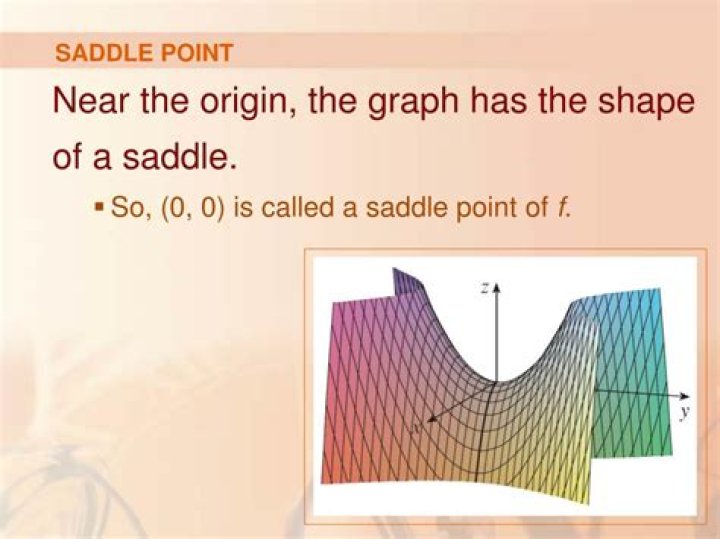
Is the point at $(0,0)$ of the graph $z=x^3 + y^3$ considered a saddle point?
I was given that function, and I used the second-order derivative test only to find that the $Hf(0,0) = 0$, with the critical point being at 0,0. Is anything that is not a local minimum or a local maximum considered a saddle point? What the graph looks like
$\endgroup$1 Answer
$\begingroup$In your case, the Hessian is a null matrix. This does not guarantee that the point is a saddle point. Although I cannot come up with an example but I think you can have a null matrix as hessian at the minima. But don't quote me for that.
Such a point, AFAIK, is given the name "Degenerate Critical Point". Whether it is considered saddle or not, I am not sure.
- If I am standing at (0,0,0) and you give me an $\epsilon$, I can step $(\epsilon,0)$ and make the function positive or $(-\epsilon,0)$ and make the function negative. So, no matter how small epsilon you give me, I can always move to points that increase the function value and reduce it. This makes the (0,0,0) a saddle point.
- Does this question help : Classifying singular points as local min, max or saddle points?