 $\begingroup$
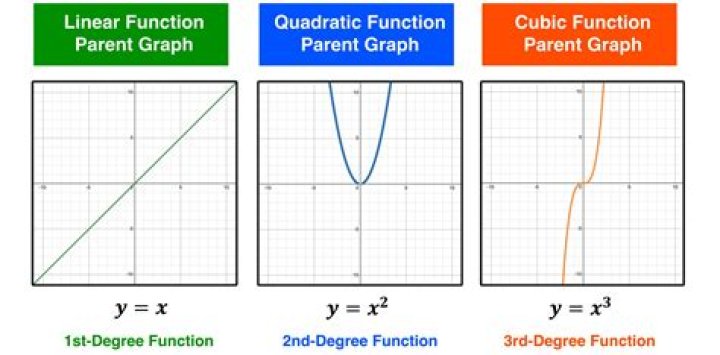
Sorry if I'm being too specific and for not showing an example but If you had a derivative of a straight line would the slope of the tangent line be the same as the straight line?
$\endgroup$36 Answers
$\begingroup$recall the formal (limit) definition of the derivative:
$$f'(x) = \lim_{h \rightarrow 0} \dfrac{f(x + h) - f(x)}{h}$$
let $f(x) = ax + b$ where $a,b$ are real numbers. Then
$\begin{equation*} \begin{split} f'(x) &= \lim_{h \rightarrow 0} \dfrac{\big(a(x + h) + b\big) - (ax + b)}{h} \\ &= \lim_{h \rightarrow 0} \dfrac{ax + ah + b - ax - b}{h} \\ &= \lim_{h \rightarrow 0} \dfrac{ah}{h} \\ &= a \end{split} \end{equation*}$
which is a horizontal line (generally speaking the derivative at a specific point is the slope of the tangent line at that point) There are a couple of important things to note:
1) a line that is already horizontal will have a slope of 0 (that is $a$ = 0) so its derivative will always be 0
2) the derivative is a function of $x$ (our independent variable) so a vertical line does not have a derivative
$\endgroup$$\begingroup$Yes, for this case the tangent and the given line are the same..Tangential contact occurs everywhere.
It can be verified that derivative of
$$ y= mx + c$$
results in a slope $$ \frac{dy}{dx} =m $$ as a constant everywhere.
$\endgroup$0$\begingroup$Yes, if you have a function of the form $$f(x) = mx + b,$$ (a line) then the derivative would be $$f'(x) = m,$$ meaning that the slope of the tangent line is $m$.
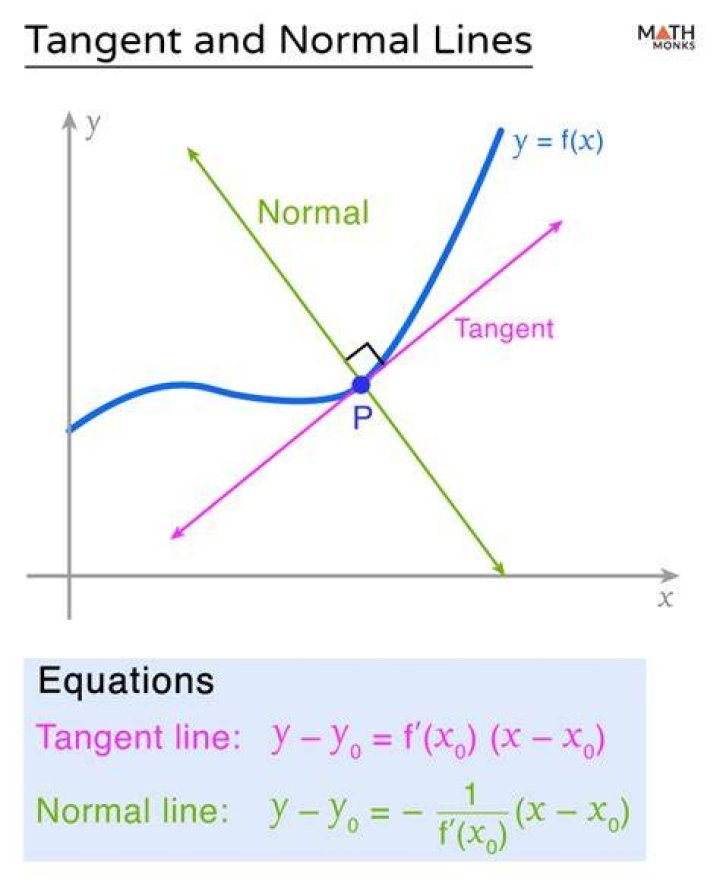
$\endgroup$$\begingroup$The tangent line at $x_{*}$ is a straight line which touches $f(x_{*})$ and has the slope equal to the derivative $f'(x)$ at the point $x_{*}$.
The tangent line includes the point $\left(x_{*}, f(x_{*})\right)$ and has a slope given by $f'(x_{*})$.
$\endgroup$$\begingroup$Yes, the best linear approximation to a linear function is the function itself. Thinking about derivatives in this way will pay off in the future if you take multivariable calculus.
$\endgroup$$\begingroup$For the function y =x you can can also rewrite as y = mx+b. Where m is slope and b is y intercept.
For a tiny change in the input x, say dx, what is the change dy for the function y =mx+b?
Keeping in mind that the derivative is equal to the slope of the line tangent to the function y =mx+b at a single point. To find the slope: y2-y1/x2-x1. Then: limit as dx-->0 of (f(x+dx) -f(x))/dx = (mx+b+dx -(mx+b))/dx = dx/dx = 1 = constant
Note: the algebra takes care of the y intercept b and the term mx, making b and mx go to zero,
Therefore dy/dx = constant Should be read in a few different ways: The rate of change of the function y = x at any point is a constant or The derivative of the function y = x, d(y)/dx is a constant or the slope of the line tangent to the function y=x at a single point is a constant. or the increase input dx increases the change in y (dy) by a constant.
or the area under the curve, A, for y = x is increased by d(A)for some input dx, and that d(A)is a constant.
$\endgroup$