 $\begingroup$
I'm currently studying for my calculus AP exam and I'm currently stuck on a question.
Unless otherwise specified, the domain of a function $f$ is assumed to be the set of all real numbers $x$ for which $f(x)$ is a real number. \begin{array}{|c|c|c|c|c|}\hline x & -3 & 0 & 3 & 6 \\ \hline f(x) & -5 & 4 & 1 & 7 \\ \hline f'(x) & -1 & 2 & -2 & 4 \\ \hline\end{array} The table above gives values of a twice-differentiable function $f$ and its first derivative $f'$ for selected values of $x$. Let $g$ be the function defined by $g(x) = f(x^{2} - x)$.
Let $h$ be the function with derivative given by $h'(x)=4e^{\cos x}$. At what value of $x$ in the interval $-3 \leq x \leq 0$ does the instantaneous rate of change of $h$ equal the average rate of change $f$ over the interval $-3 \leq x \leq 0$?
I don't need someone to spoonfeed me the answer, but if someone would be able to tell me what theorem or what the first step or two I need to take to get started would be great. Thanks!
$\endgroup$11 Answer
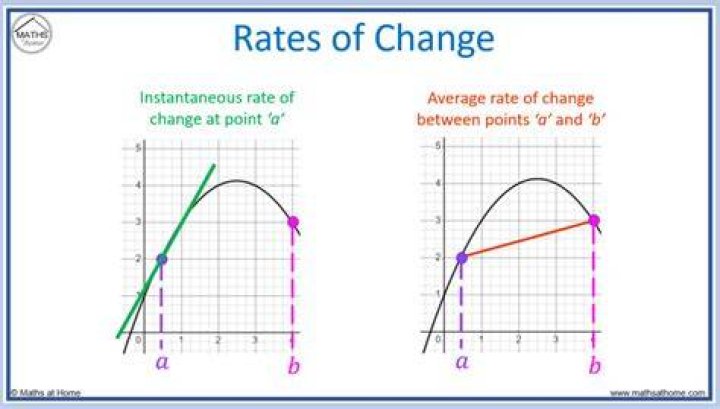
$\begingroup$The average rate of change is the slope of the line connecting the two endpoints at $(-3, f(-3))$ and $(0, f(0))$.
It is givn by $$\frac{f(0)-f(-3)}{0-(-3)}$$
The instantaneous rate of change is the derivative $4e^{\cos x}$.
Now you must find the $x$ such that the instanteous rate of change of $h(x)$ equals the average change of $f(x)$ over the interval. Hopefully there is such an $x$!
$\endgroup$