 $\begingroup$
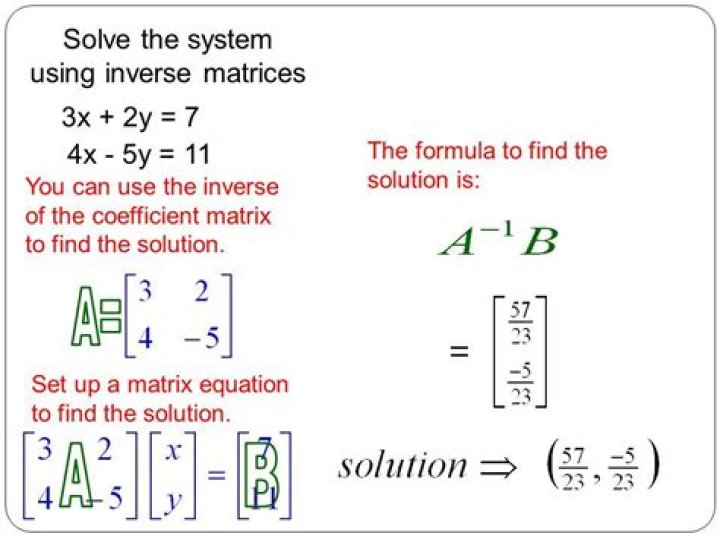
If the determinant of a coefficient matrix is 0, can you use inverse matrices to solve the system of equations? Explain your answer.
I believe the answer is no, because if our determinant is equal to 0 then we cannot have a inverse matrix since we cannot divide by 0.
Is this the correct answer or somewhat close?
$\endgroup$23 Answers
$\begingroup$The answer is no. If a matrix has a determinant of $0$, it can't have an inverse.
A proof of this is as follows: let $A$ be a matrix whose determinant is $0$, and suppose that $B$ were a matrix such that $AB = I$. We know that $$ 1 = \det(I) = \det(AB) = \det(A)\cdot\det(B) = 0\cdot \det(B) $$ That is, we would find that $B$ is a matrix whose determinant satisfies $0\cdot \det(B) = 1$. Since zero times anything is zero, no such matrix $B$ can exist.
So, $A$ cannot have an inverse.
Note, however, that even if $A$ has a determinant of zero, the system $A x = b$ still might have a solution. It just so happens that whenever an $A$ with determinant zero has a solution, it must have infinitely many other solutions as well.
$\endgroup$$\begingroup$If you have a linear system $Ax=b$ and $\det(A)=0$ you cannot get $b=A^{-1}x$ since $A^{-1}$ doesn't exists.
However you can use inverse matrices to solve the system after a careful study of it. Let me explain with an example. If $Ax=b$ and $\det(A)=0,$ assuming the system is compatible, it must be an indeterminate system. For example
$$\left\{ \begin{array}{rcl} x+y+z & = & 3 \\ x+y-z & = & 1 \\ 2x+2y & = & 4\end{array}\right.$$
is a compatible system with $\det(A)=0.$ This is due to the fact that the third equation is the sum of the other two. So the system is equivalent to
$$\left\{ \begin{array}{rcl} x+y+z & = & 3 \\ x+y-z & = & 1 \end{array}\right.$$ which is a compatible system, but indeterminate. We can write it as
$$\left\{ \begin{array}{rcl} y+z & = & 3-x \\ y-z & = & 1-x \end{array}\right.$$ or equivalently
$$\left(\begin{matrix}1 & 1 \\ 1 & -1\end{matrix}\right)\left(\begin{matrix}y\\ z\end{matrix}\right)=\left(\begin{matrix}3-x\\1-x\end{matrix}\right).$$ Now we can do
$$\left(\begin{matrix}y\\ z\end{matrix}\right)=\left(\begin{matrix}1 & 1 \\ 1 & -1\end{matrix}\right)^{-1}\left(\begin{matrix}3-x\\1-x\end{matrix}\right)$$ to get
$$\left\{ \begin{array}{rcl} y & = & 2-x \\ z & = & 1 \end{array}\right.$$ and write the solution as a parametric line
$$\left\{ \begin{array}{rcl} x & = & \lambda, \\ y & = & 2-\lambda, \\ z & = & 1, \end{array}\right. \qquad \lambda\in\Bbb{R}.$$
Note that it doesn't work if we write
$$\left\{ \begin{array}{rcl} x+y & = & 3-z \\ x+y & = & 1+z \end{array}\right.$$
So, in general, if you have an indeterminate system ($\det A=0$) you have to look for the largest non-vanishing minor and proceed as in the example.
$\endgroup$$\begingroup$I am not sure about your terms. If the equation of the linear system is
$$ A x = b \quad (*) $$
and you call $A$ a coefficient matrix, $x$ a solution vector and $b$ a target vector (or whatever), then you need
$$ \det A \ne 0 $$
for $A^{-1}$ to exist, so you can not use such.
Why does $\det A = 0$ deny an inverse for $A$?
If the determinant vanishes, that means that the oriented paralellepiped volume formed by the $n$ column vectors of $A$ is degenerated, so they can not be linear independent. That in turn means that $\dim \mbox{rg} A < n$ and thus $\dim \mbox{ker} A > 0$ which denies a unique solution $x$, as all vectors from $x + \mbox{ker} A$ would solve $(*)$.
If a right-inverse matrix $B$ to $A$ would exist, we would have $A B = E$. And we would have $A B' = E$ too, where $B' = B + x_k \ne B$ is a matrix where some non-trivial $x_k \in \mbox{ker} A$ is added to one of the column vectors from $B$, yielding another, different right-inverse of $A$.
However a right-inverse of a matrix is a left-inverse as well: $$ C A = E = A B \implies (C A) B = (AB) B \iff C (AB) = E B \iff C = B $$ and it should be unique: $$ A B' = E = A B \implies B (AB') = B(AB) \iff (BA)B' = (BA) B \iff B' = B $$ which contradicts that we found a second one.
Note: user $\mbox{Om}(\mbox{nom})^3$ is right that even without existing $A^{-1}$ the equation $A x = b$ might hold and has a solution.
Example: $$ \left[ \begin{matrix} 1 & 1 \\ 2 & 2 \end{matrix} \right] \left[ \begin{matrix} 4 \\ 2 \end{matrix} \right] = \left[ \begin{matrix} 6 \\ 12 \end{matrix} \right] $$
$\endgroup$0