 $\begingroup$
Question: Suppose that $A\in B$, does this imply that $A\subset B$? If so, why?
I have tried to look at using the following example:
Suppose that $A = 4$ and $B = \{4\}$. We definitely have $A \in B$, but I'm not sure whether this implies $A\subset B$, since $A$ is not even a set, but a number.
I read here that an element of a set can be a subset of a set. But I don't think that it mentions $A\in B \Rightarrow A\subset B$.
$\endgroup$13 Answers
$\begingroup$You are correct all the way through. $A\in B$ does not imply $A\subseteq B$ (and indeed $4\in\{4\}$ but the only subsets of $\{4\}$ are: $\emptyset$ and the whole set $\{4\}$).
Sometimes something can be an element of a set and a subset of it, e.g. $\emptyset\in\{\emptyset\}$ and $\emptyset\subseteq\{\emptyset\}$, though (unless you are a set theorist) this is more of a curiosity.
$\endgroup$$\begingroup$This is generally wrong. If $A$ is an element of $B$, then we can write $B= \{A,\ldots\}$.
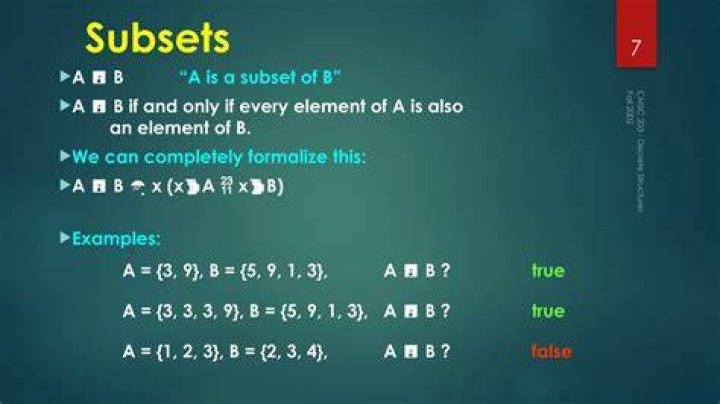
A set $A$ is a SUBSET of a set $B$ iff each element $x$ of $A$ is also an element of $B$.
In your case, $A$ is a subset of $B$ would require that $A$ is an element of $A$; the latter would be a cyclic definition of a set: $A=\{A,\ldots\}$.
$\endgroup$$\begingroup$This property is one of the properties defining ordinals, in von Neumann's definition:
it is a set $X$ such that
- The relation $\in$ on elements of $X$ is a strict order and $X$ is well-ordered by this relation.
- $X$ is transitive, i.e. $\;\forall x\in X, \:x\subset X$.
For instance, natural numbers are ordinals, and their set $\mathbf N$ is the first transfinite ordinal. Transfinite ordinals are particularly useful for proofs by transfinite induction.
Elementary examples of this situation: a construction of the set of natural numbers:
$0$ being defined as $\varnothing$, $\; 1=\{\varnothing\}$, $\:2=\{\varnothing,\{\varnothing\}\}$, $\:3=\{\varnothing,\{\varnothing\},\{\varnothing,\{\varnothing\}\}\}$, &c.
$\endgroup$6