How can I get the tree of a module available to npm, but not installed locally ?
npm ll does the job for locally installed packages. But it doesn't work for modules not installed or modules installed globally.
I tried npm list bower but that's not it.
11 Answers
You can generate NPM dependency trees without the need of installing a dependency by using the command
npm list This will generate a dependency tree for the project at the current directory and print it to the console.
You can get the dependency tree of a specific dependency like so:
npm list [dependency] You can also set the maximum depth level by doing
npm list --depth=[depth] Note that you can only view the dependency tree of a dependency that you have installed either globally, or locally to the NPM project.
8You can use the npm-remote-ls module. You can install it globally:
npm install -g npm-remote-ls And then call:
npm-remote-ls bower Alternatively, npm@5.2.0 installed then you can use npx and avoid globally installing the command - just call:
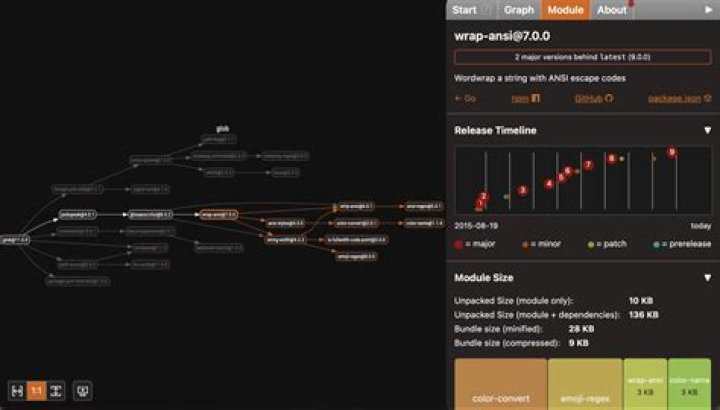
npx npm-remote-ls bower This site allows you to view a packages tree as a node graph in 2D or 3D.
Great work from @Avanka!
3Here is the unpowerful official command:
npm view <PACKAGE> dependencies It prints only the direct dependencies, not the whole tree.
2You can use howfat which also displays dependency statistics:
npx howfat -r tree jasmine 
If you want to get the actually dependency path of specific package and want to know why you have it, you can simply ask yarn why <MODULE>. example:
$> yarn why mime-db yarn why v1.5.1 [1/4] Why do we have the module "mime-db"...? [2/4] Initialising dependency graph... [3/4] Finding dependency... [4/4] Calculating file sizes... => Found "mime-db@1.37.0" info Reasons this module exists - "coveralls#request#mime-types" depends on it - Hoisted from "coveralls#request#mime-types#mime-db" info Disk size without dependencies: "196kB" info Disk size with unique dependencies: "196kB" info Disk size with transitive dependencies: "196kB" info Number of shared dependencies: 0 Done in 0.65s. View All the metadata about npm module
npm view mongoose(module name) View All Dependencies of module
npm view mongoose dependencies View All Version or Versions module
npm view mongoose version npm view mongoose versions View All the keywords
npm view mongoose keywords To get it as a list:
% npx npm-remote-ls --flatten dugite -d false -o false [ 'dugite@1.91.3', 'checksum@0.1.1', 'progress@2.0.3', 'mkdirp@0.5.5', 'rimraf@2.7.1', 'tar@4.4.13', 'optimist@0.3.7', 'got@9.6.0', 'minimist@1.2.5', 'chownr@1.1.4', 'glob@7.1.6', 'fs-minipass@1.2.7', 'minizlib@1.3.3', 'minipass@2.9.0', 'safe-buffer@5.2.1', 'yallist@3.1.1', 'wordwrap@0.0.3', '@szmarczak/http-timer@1.1.2', 'cacheable-request@6.1.0', '@sindresorhus/is@0.14.0', 'decompress-response@3.3.0', 'duplexer3@0.1.4', 'lowercase-keys@1.0.1', 'mimic-response@1.0.1', 'get-stream@4.1.0', 'to-readable-stream@1.0.0', 'p-cancelable@1.1.0', 'url-parse-lax@3.0.0', 'fs.realpath@1.0.0', 'inflight@1.0.6', 'inherits@2.0.4', 'once@1.4.0', 'path-is-absolute@1.0.1', 'minimatch@3.0.4', 'defer-to-connect@1.1.3', 'clone-response@1.0.2', 'get-stream@5.2.0', 'http-cache-semantics@4.1.0', 'lowercase-keys@2.0.0', 'responselike@1.0.2', 'keyv@3.1.0', 'pump@3.0.0', 'prepend-http@2.0.0', 'normalize-url@4.5.0', 'wrappy@1.0.2', 'brace-expansion@1.1.11', 'json-buffer@3.0.0', 'end-of-stream@1.4.4', 'concat-map@0.0.1', 'balanced-match@1.0.0' ] If you are using yarn, then you can go with yarn list from the root directory of the project. It'll give you a tree like structure of all the transitive dependencies like below:
├─ @ampproject/toolbox-core@2.7.4 │ ├─ cross-fetch@3.0.6 │ └─ lru-cache@6.0.0 ├─ @ampproject/toolbox-optimizer@2.7.0-alpha.1 │ ├─ @ampproject/toolbox-core@^2.6.0 │ ├─ @ampproject/toolbox-runtime-version@^2.7.0-alpha.1 │ ├─ @ampproject/toolbox-script-csp@^2.5.4 │ ├─ @ampproject/toolbox-validator-rules@^2.5.4 │ ├─ abort-controller@3.0.0 │ ├─ cross-fetch@3.0.5 │ ├─ cross-fetch@3.0.5 │ │ └─ node-fetch@2.6.0 │ ├─ cssnano-preset-simple@1.2.0 │ │ ├─ caniuse-lite@^1.0.30001093 │ │ ├─ postcss@^7.0.32 │ │ └─ postcss@7.0.35 │ │ ├─ chalk@^2.4.2 │ │ ├─ source-map@^0.6.1 │ │ └─ supports-color@^6.1.0 There is also a nice web app to see the dependencies in a weighted map kind of view.
For example:
Unfortunately npm still doesn't have a way to view dependencies of non-installed packages. Not even a package's page list the dependencies correctly. 🙄
Luckily installing yarn:
brew install yarn
Allows one to use its info command to view accurate dependencies:
yarn info @angular/router@4.4.7 dependencies
yarn info @angular/router@4.4.7 peerDependencies