I want to create simple tables, insert values in it, and do queries. How to perform them in the terminal?
5 Answers
Here is the syntax to execute sql statement from terminal
I'm assuming that you are using MySQL.
Syntax:
mysql -u user_name -p password -e 'SQL Query' database Clearificance:
-u : Specify mysql database user name -p : Prompt for password -e : Execute sql query database : Specify database name Example:
If you want to create a table
personthen:mysql -u root -p -e 'Create table person(PersonID int, LastName varchar(255), FirstName varchar(255))' mydbwhere
rootis the username,mydbis the name of the database. Similary you can execute any query you want.If you want to
insertvalues inperson:mysql -u root -p -e 'Insert into person(PersonID,LastName,FirstName) Values(100,"Kumar","Saurav")' mydbIf you want to select all the information from
personand want to save in a file:mysql -u root -p -e 'Select * from person' mydb > personinfo
And of-course you can create a database using terminal itself
To create database mydb execute following command in terminal:
mysql -u root -p -e 'create database mydb'it will silently create a database mydb without giving any message/output.
To list all the databases execute this command in terminal:
mysql -u root -p -e 'show databases'
Hope it helps you.. Reply if you need further assistance..
You make a database by typing
mysql In the prompt you enter, you then start by creating your database (as explained by onik in the comments):
CREATE DATABASE dbname Once you have made that database, you can experiment with it. You can simply type mysql in a terminal and you can get do anything sql related you want. It is possible that you have create to a role in your database with your username.
As described in Sauruv's answer you can also connect to the database as follows (without the space between p and your password or better, just do not use the -p option and you will get a password prompt [credits go to onik]):
Syntax:
mysql -u user_name -ppassword dbname -u : Specify mysql database user name -p : Prompt for password dbname : Specify database name mycli
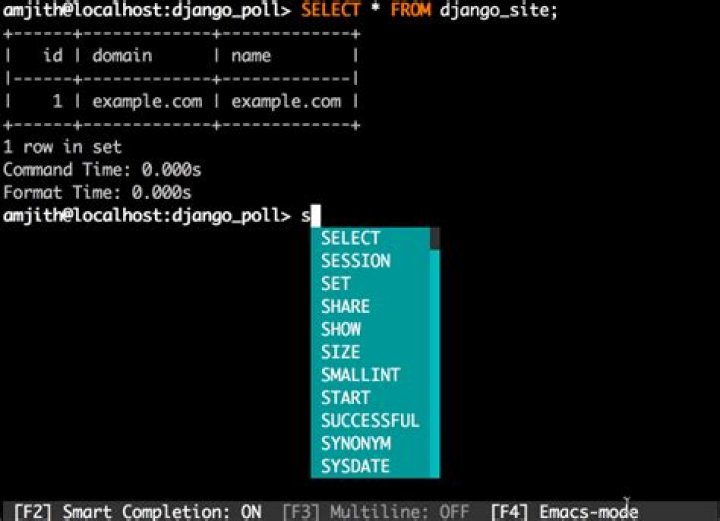
mysql default console is fine and pretty, but maybe prettier is mycli (and it Postgres alternative, pgcli).
Installation: On Ubuntu 16.04+ is on official repos: sudo apt install mycli
$ mycli --help Usage: mycli [OPTIONS] [DATABASE] A MySQL terminal client with auto-completion and syntax highlighting. Examples: - mycli my_database - mycli -u my_user -h my_host.com my_database - mycli mysql://my_user@my_host.com:3306/my_database 
Reference
- HomePage
- Documentation
- Github repo
- nixCraft post about
mycli
mysql is a simple command-line tool. mysql is command line and it is very easy to use. Invoke it from the prompt of your command interpreter as follows:
$ mysql Output
mysql> You may need to provide mysql username, password and hostname, use:
$ mysql --user=your-user-name --password=your-password mysql> To list database type the following command
mysql> show databases; Output
+--------------------+ | Database | +--------------------+ | information_schema | | mysql | +--------------------+ 2 rows in set (0.00 sec) information_schema and mysql are name of databases. To use these database and to list available tables type the following two commands:
mysql> use mysql; Output:
Reading table information for completion of table and column names You can turn off this feature to get a quicker startup with -A Database changed Now list tables:
mysql> show tables; Output:
+---------------------------+ | Tables_in_mysql | +---------------------------+ | columns_priv | | db | | func | | help_category | | help_keyword | | help_relation | | help_topic | | host | | proc | | procs_priv | | tables_priv | | time_zone | | time_zone_leap_second | | time_zone_name | | time_zone_transition | | time_zone_transition_type | | user | +---------------------------+ 17 rows in set (0.00 sec) mysql> There is sqlline which could connect to any rdbms (Oracle, mysql, postgres, h2 and others), also csv, cassandra, elastic-search, mongo (via apache-calcite).
There is a project demos page with short demo videos It provides multiline-editing, syntax highlighting, smart autocompletion, dialect support.
It could be embedded and no need to install it.