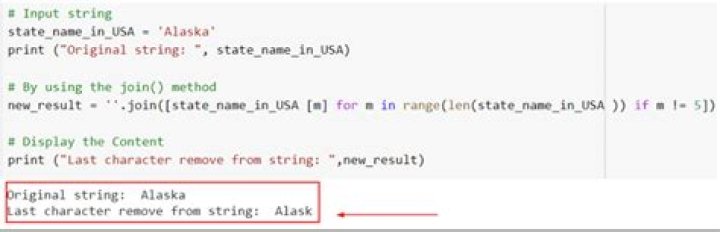

I want to remove the last character from a string. I've tried doing this:
public String method(String str) { if (str.charAt(str.length()-1)=='x'){ str = str.replace(str.substring(str.length()-1), ""); return str; } else{ return str; } } Getting the length of the string - 1 and replacing the last letter with nothing (deleting it), but every time I run the program, it deletes middle letters that are the same as the last letter.
For example, the word is "admirer"; after I run the method, I get "admie." I want it to return the word admire.
038 Answers
replace will replace all instances of a letter. All you need to do is use substring():
public String method(String str) { if (str != null && str.length() > 0 && str.charAt(str.length() - 1) == 'x') { str = str.substring(0, str.length() - 1); } return str; } Why not just one liner?
public static String removeLastChar(String str) { return removeLastChars(str, 1); } public static String removeLastChars(String str, int chars) { return str.substring(0, str.length() - chars); } Full Code
public class Main { public static void main (String[] args) throws java.lang.Exception { String s1 = "Remove Last CharacterY"; String s2 = "Remove Last Character2"; System.out.println("After removing s1==" + removeLastChar(s1) + "=="); System.out.println("After removing s2==" + removeLastChar(s2) + "=="); } public static String removeLastChar(String str) { return removeLastChars(str, 1); } public static String removeLastChars(String str, int chars) { return str.substring(0, str.length() - chars); } } Demo
5Since we're on a subject, one can use regular expressions too
"aaabcd".replaceFirst(".$",""); //=> aaabc The described problem and proposed solutions sometimes relate to removing separators. If this is your case, then have a look at Apache Commons StringUtils, it has a method called removeEnd which is very elegant.
Example:
StringUtils.removeEnd("string 1|string 2|string 3|", "|"); Would result in: "string 1|string 2|string 3"
1public String removeLastChar(String s) { if (s == null || s.length() == 0) { return s; } return s.substring(0, s.length()-1); } Don't try to reinvent the wheel, while others have already written libraries to perform string manipulation: org.apache.commons.lang3.StringUtils.chop()
In Kotlin you can used dropLast() method of the string class. It will drop the given number from string, return a new string
var string1 = "Some Text" string1 = string1.dropLast(1) Use this:
if(string.endsWith("x")) { string= string.substring(0, string.length() - 1); } if (str.endsWith("x")) { return str.substring(0, str.length() - 1); } return str; For example, the word is "admirer"; after I run the method, I get "admie." I want it to return the word admire.
In case you're trying to stem English words
Stemming is the process for reducing inflected (or sometimes derived) words to their stem, base or root form—generally a written word form.
...
A stemmer for English, for example, should identify the string "cats" (and possibly "catlike", "catty" etc.) as based on the root "cat", and "stemmer", "stemming", "stemmed" as based on "stem". A stemming algorithm reduces the words "fishing", "fished", "fish", and "fisher" to the root word, "fish".
Difference between Lucene stemmers: EnglishStemmer, PorterStemmer, LovinsStemmer outlines some Java options.
As far as the readability is concerned, I find this to be the most concise
StringUtils.substring("string", 0, -1); The negative indexes can be used in Apache's StringUtils utility. All negative numbers are treated from offset from the end of the string.
1 string = string.substring(0, (string.length() - 1)); I'm using this in my code, it's easy and simple. it only works while the String is > 0. I have it connected to a button and inside the following if statement
if (string.length() > 0) { string = string.substring(0, (string.length() - 1)); } public String removeLastChar(String s) { if (!Util.isEmpty(s)) { s = s.substring(0, s.length()-1); } return s; } removes last occurence of the 'xxx':
System.out.println("aaa xxx aaa xxx ".replaceAll("xxx([^xxx]*)$", "$1")); removes last occurrence of the 'xxx' if it is last:
System.out.println("aaa xxx aaa ".replaceAll("xxx\\s*$", "")); you can replace the 'xxx' on what you want but watch out on special chars
// creating StringBuilder StringBuilder builder = new StringBuilder(requestString); // removing last character from String builder.deleteCharAt(requestString.length() - 1); How can a simple task be made complicated. My solution is:
public String removeLastChar(String s) { return s[0..-1] } or
public String removeLastChar(String s) { if (s.length() > 0) { return s[0..-1] } return s } Look to StringBuilder Class :
StringBuilder sb=new StringBuilder("toto,"); System.out.println(sb.deleteCharAt(sb.length()-1));//display "toto" // Remove n last characters // System.out.println(removeLast("Hello!!!333",3)); public String removeLast(String mes, int n) { return mes != null && !mes.isEmpty() && mes.length()>n ? mes.substring(0, mes.length()-n): mes; } // Leave substring before character/string // System.out.println(leaveBeforeChar("Hello!!!123", "1")); public String leaveBeforeChar(String mes, String last) { return mes != null && !mes.isEmpty() && mes.lastIndexOf(last)!=-1 ? mes.substring(0, mes.lastIndexOf(last)): mes; } A one-liner answer (just a funny alternative - do not try this at home, and great answers already given):
public String removeLastChar(String s){return (s != null && s.length() != 0) ? s.substring(0, s.length() - 1): s;} Most answers here forgot about surrogate pairs.
For instance, the character 𝕫 (codepoint U+1D56B) does not fit into a single char, so in order to be represented, it must form a surrogate pair of two chars.
If one simply applies the currently accepted answer (using str.substring(0, str.length() - 1), one splices the surrogate pair, leading to unexpected results.
One should also include a check whether the last character is a surrogate pair:
public static String removeLastChar(String str) { Objects.requireNonNull(str, "The string should not be null"); if (str.isEmpty()) { return str; } char lastChar = str.charAt(str.length() - 1); int cut = Character.isSurrogate(lastChar) ? 2 : 1; return str.substring(0, str.length() - cut); } Java 8
import java.util.Optional; public class Test { public static void main(String[] args) throws InterruptedException { System.out.println(removeLastChar("test-abc")); } public static String removeLastChar(String s) { return Optional.ofNullable(s) .filter(str -> str.length() != 0) .map(str -> str.substring(0, str.length() - 1)) .orElse(s); } } Output : test-ab
public String removeLastCharacter(String str){ String result = null; if ((str != null) && (str.length() > 0)) { return str.substring(0, str.length() - 1); } else{ return ""; } } if we want to remove file extension of the given file,
** Sample code
public static String removeNCharactersFromLast(String str,int n){ if (str != null && (str.length() > 0)) { return str.substring(0, str.length() - n); } return ""; } if you have special character like ; in json just use String.replace(";", "") otherwise you must rewrite all character in string minus the last.
Why not use the escape sequence ... !
System.out.println(str + '\b'); Life is much easier now . XD ! ~ A readable one-liner
2How to make the char in the recursion at the end:
public static String removeChar(String word, char charToRemove) { String char_toremove=Character.toString(charToRemove); for(int i = 0; i < word.length(); i++) { if(word.charAt(i) == charToRemove) { String newWord = word.substring(0, i) + word.substring(i + 1); return removeChar(newWord,charToRemove); } } System.out.println(word); return word; } for exemple:
removeChar ("hello world, let's go!",'l') → "heo word, et's go!llll" removeChar("you should not go",'o') → "yu shuld nt goooo" Here's an answer that works with codepoints outside of the Basic Multilingual Plane (Java 8+).
Using streams:
public String method(String str) { return str.codePoints() .limit(str.codePoints().count() - 1) .mapToObj(i->new String(Character.toChars(i))) .collect(Collectors.joining()); } More efficient maybe:
public String method(String str) { return str.isEmpty()? "": str.substring(0, str.length() - Character.charCount(str.codePointBefore(str.length()))); } just replace the condition of "if" like this:
if(a.substring(a.length()-1).equals("x"))' this will do the trick for you.
Suppose total length of my string=24 I want to cut last character after position 14 to end, mean I want starting 14 to be there. So I apply following solution.
String date = "2019-07-31T22:00:00.000Z"; String result = date.substring(0, date.length() - 14); I had to write code for a similar problem. One way that I was able to solve it used a recursive method of coding.
static String removeChar(String word, char charToRemove) { for(int i = 0; i < word.lenght(); i++) { if(word.charAt(i) == charToRemove) { String newWord = word.substring(0, i) + word.substring(i + 1); return removeChar(newWord, charToRemove); } } return word; } Most of the code I've seen on this topic doesn't use recursion so hopefully I can help you or someone who has the same problem.
Easy Peasy:
StringBuilder sb= new StringBuilder(); for(Entry<String,String> entry : map.entrySet()) { sb.append(entry.getKey() + "_" + entry.getValue() + "|"); } String requiredString = sb.substring(0, sb.length() - 1);