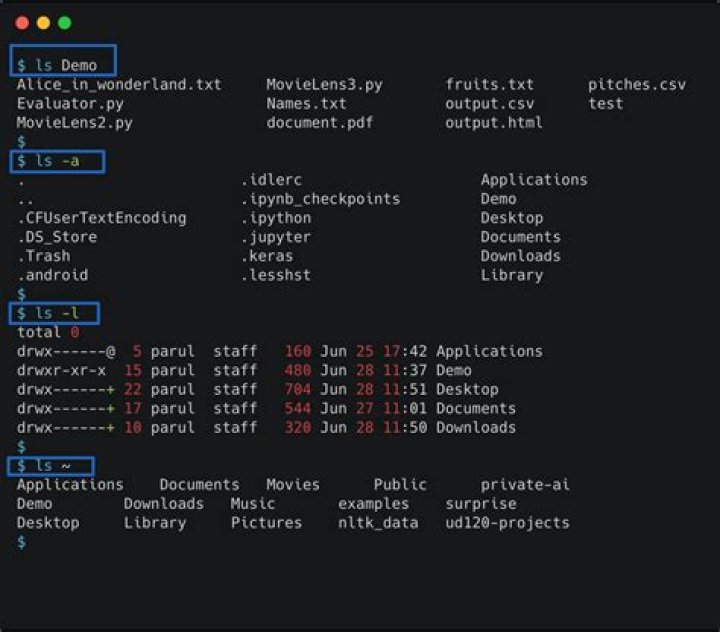

Is there any way to list just the folders in a directory using bash commands? ( as the ls command lists all the files and folders )
8 Answers
You can use:
ls -d -- */ Since all directories end in /, this lists only the directories in the current path. The -d option ensures that only the directory names are printed, not their contents.
Stephen Martin's response gave a warning, and listed the current folder as well, so I'd suggest
find . -mindepth 1 -maxdepth 1 -type d (This is on Linux; I could not find -maxdepth and -mindepth in the POSIX man page for find)
1find . -maxdepth 1 -type d Will list just folders. And as Teddy pointed out you'll need -maxdepth to stop it recusrsing into sub dirs
1Daniel’s answer is correct. Here are some useful additions, though.
To avoid listing hidden folders (like .git), try this:
find . -mindepth 1 -maxdepth 1 -type d \( ! -iname ".*" \) And to replace the dreaded dot slash at the beginning of find output in some environments, use this:
find . -mindepth 1 -maxdepth 1 -type d \( ! -iname ".*" \) | sed 's|^\./||g' You're "not supposed to" parse the output of ls, or so is said. The reasoning behind is that the output is intended to be human-readable and that can make it unnecessarily complicated to parse, if I recall.
if you don't want ls or find, you may want to try filtering "*" with "[ -d ]".
I did just that, for some reason ls and find weren't working (file names with spaces and brackets I guess, or somthing else I was overlooking), then I did something along the lines of
for f in * ; do [ -d "$f" ] && echo $f is indeed a folder ; done Just to emphasize a thing that confused me out here, in respect to glob patterns selection; say you have this:
$ cd /tmp $ mkdir testglob $ for ix in {00,01,02,03} ; do mkdir testglob/mydir_${ix} ; done $ for ix in {00,01,02,03} ; do touch testglob/myfile_${ix} ; done $ for ix in {00,01,02,03} ; do touch testglob/mydir_${ix}.txt ; done $ for ix in {00,01,02,03} ; do mkdir testglob/otherdir_${ix} ; done $ tree testglob/ testglob/ ├── mydir_00 ├── mydir_00.txt ├── mydir_01 ├── mydir_01.txt ├── mydir_02 ├── mydir_02.txt ├── mydir_03 ├── mydir_03.txt ├── myfile_00 ├── myfile_01 ├── myfile_02 ├── myfile_03 ├── otherdir_00 ├── otherdir_01 ├── otherdir_02 └── otherdir_03 8 directories, 8 files So, say here you want to select only mydir* directories. Note that if you leave out the terminating slash, ls -d will list files as well:
$ ls -d testglob/mydir* # also `ls -d -- testglob/mydir*` testglob/mydir_00 testglob/mydir_01 testglob/mydir_02 testglob/mydir_03 testglob/mydir_00.txt testglob/mydir_01.txt testglob/mydir_02.txt testglob/mydir_03.txt ... however, with a terminating slash, then only directories are listed:
$ ls -d testglob/mydir*/ # also `ls -d -- testglob/mydir*/` testglob/mydir_00/ testglob/mydir_01/ testglob/mydir_02/ testglob/mydir_03/ printf "%s\n" */ will list all directories in the $PWD.
echo */ will also work, but in a long one-line, more difficult when names have spaces.
You can also use:
du Or:
git ls-tree -d -r --name-only @