 $\begingroup$
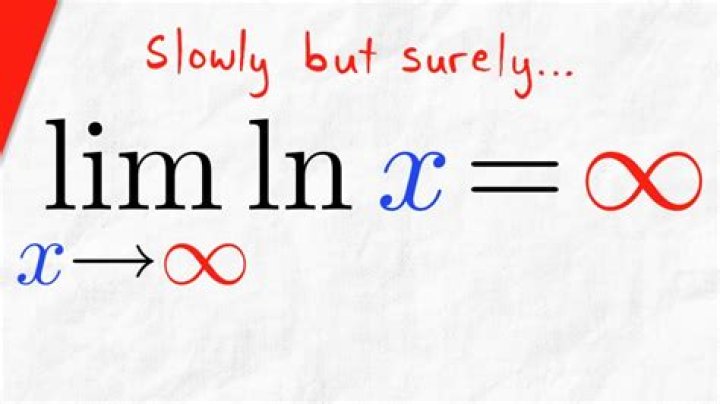
So $\lim_{x \to 0^+} \ln x = -\infty$. If you draw the graph then it's very obvious. But without drawing a graph, how do we know it's $-\infty$ as opposed to $+\infty$?
$\endgroup$56 Answers
$\begingroup$Hint: $\displaystyle\lim_{n\to\infty}\log(e^{-n})=\lim_{n\to\infty}-n.$
$\endgroup$$\begingroup$How do we know $[\lim\limits_{x\to0^+}\ln x]$ is $-\infty$ as opposed to $+\infty$?
Well, if $x<1$ then $\ln x<0$.
$\endgroup$$\begingroup$If you buy that $\lim\limits_{x\to \color{blue}{-\infty}} e^{x} = \color{red}{0}$, which you should since $e>1$, you can rephrase this using inverse functions to deduce $\lim\limits_{\xi \to \color{red}{0^+}} \ln(\xi)=\color{blue}{-\infty}$.
$\endgroup$$\begingroup$Without being super rigorous, you know the function ${y=e^{x}}$ grows without bound as ${x\rightarrow \infty}$. This means
$${\lim_{x\rightarrow\infty}e^{-x}=\lim_{x\rightarrow\infty}\frac{1}{e^{x}}=0}$$
Which is equivalent to
$${\lim_{x\rightarrow -\infty}e^{x}=0}$$
And because the natural logarithm is meant to be the inverse of the exponential function, you can see that as ${x\rightarrow 0^{+}}$, ${\ln(x)}$ should diverge to ${-\infty}$.
$\endgroup$$\begingroup$Well, applying L'Hôpital's rule, we see that $$L=\lim_{x\to 0} \ln x=\lim_{x\to 0}\frac{x\ln x}{x}=\lim_{x\to 0}\frac{\ln x+1}{1}=L+1$$
which implies that $L=\pm \infty$
Now just show $\ln(x)$ is decreasing to prove that $L=-\infty$
$\endgroup$$\begingroup$Keep in mind that if $ y=\phi(x) $ is a monotone increasing function, then $x=\phi^{-1}(y)$ is also monotone increasing. In your case case $\phi^{-1}(y) = e^{y} = x$. Now, take $x \to 0^{+}$, you see that $e^{y}$ is monotone decreasing and tends to $0$.
$\endgroup$