
I'm developing a website in Angular 2 using TypeScript and I was wondering if there was a way to implement thread.sleep(ms) functionality.
My use case is to redirect the users after submitting a form after a few seconds which is very easy in JavaScript but I'm not sure how to do it in TypeScript.
28 Answers
You have to wait for TypeScript 2.0 with async/await for ES5 support as it now supported only for TS to ES6 compilation.
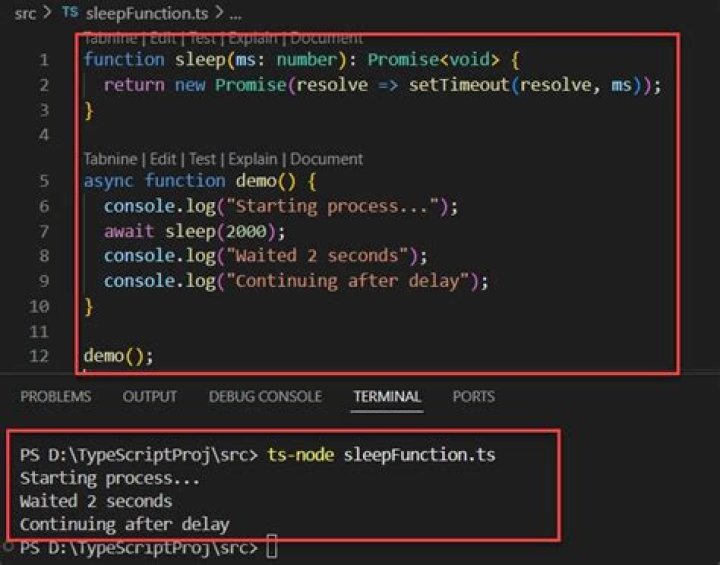
You would be able to create delay function with async:
function delay(ms: number) { return new Promise( resolve => setTimeout(resolve, ms) ); } And call it
await delay(1000); BTW, you can await on Promise directly:
await new Promise(f => setTimeout(f, 1000)); Please note, that you can use await only inside async function.
If you can't (let's say you are building nodejs application), just place your code in the anonymous async function. Here is an example:
(async () => { // Do something before delay console.log('before delay') await delay(1000); // Do something after console.log('after delay') })(); In OLD JS you have to use
setTimeout(YourFunctionName, Milliseconds); or
setTimeout( () => { /*Your Code*/ }, Milliseconds ); However with every major browser supporting async/await it is less useful.
Update: TypeScript 2.1 is here with
async/await.
Just do not forget that you need Promise implementation when you compile to ES5, where Promise is not natively available.
PS
You have to export the function if you want to use it outside of the original file.
9This works: (thanks to the comments)
setTimeout(() => { this.router.navigate(['/']); }, 5000); For some reason the above accepted answer does not work in New versions of Angular (V6).
for that use this..
async delay(ms: number) { await new Promise(resolve => setTimeout(()=>resolve(), ms)).then(()=>console.log("fired")); } above worked for me.
Usage:
this.delay(3000); OR more accurate way
this.delay(3000).then(any=>{ //your task after delay. }); With RxJS:
import { timer } from 'rxjs'; // ... timer(your_delay_in_ms).subscribe(x => { your_action_code_here }) x is 0.
If you give a second argument period to timer, a new number will be emitted each period milliseconds (x = 0 then x = 1, x = 2, ...).
See the official doc for more details.
2Or rather than to declare a function, simply:
setTimeout(() => { console.log('hello'); }, 1000); import { timer } from 'rxjs'; import { take } from 'rxjs/operators'; await timer(1000).pipe(take(1)).toPromise(); this works better for me
3If you are using angular5 and above, please include the below method in your ts file.
async delay(ms: number) { await new Promise(resolve => setTimeout(()=>resolve(), ms)).then(()=>console.log("fired")); } then call this delay() method wherever you want.
e.g:
validateInputValues() { if (null == this.id|| this.id== "") { this.messageService.add( {severity: 'error', summary: 'ID is Required.'}); this.delay(3000).then(any => { this.messageService.clear(); }); } } This will disappear message growl after 3 seconds.
You can also use RxJS:
import { of } from 'rxjs'; import { delay } from 'rxjs/operators'; async yourFunction() { yourCode; await this.delay(5000); yourCode; } delay(ms: number): Promise<any> { const dummyObservable = of(); return dummyObservable.pipe(delay(ms)).toPromise(); }