dependency:tree can be used to see the dependency tree for a given project. But what I need is to see the dependency tree for a 3rd party artifact.
I guess I can create an empty project, but I'm looking for something easier (I need to do this for several artifacts).
110 Answers
1) Use maven dependency plugin
Create a simple project with pom.xml only. Add your dependency and run:
mvn dependency:tree (Version for multi-module Maven project: mvn compile dependency:tree )
Unfortunately dependency mojo must use pom.xml or you get following error:
Cannot execute mojo: tree. It requires a project with an existing pom.xml, but the build is not using one.
2) Find pom.xml of your artifact in maven central repository
Dependencies are described In pom.xml of your artifact. Find it using maven infrastructure.
Go to and enter your groupId and artifactId.
Or you can go to and navigate first using plugins groupId, later using artifactId and finally using its version.
For example see org.springframework:spring-core
3) Use maven dependency plugin against your artifact
Part of dependency artifact is a pom.xml. That specifies it's dependency. And you can execute mvn dependency:tree on this pom.
7If you bother creating a sample project and adding your 3rd party dependency to that, then you can run the following in order to see the full hierarchy of the dependencies.
You can search for a specific artifact using this maven command:
mvn dependency:tree -Dverbose -Dincludes=[groupId]:[artifactId]:[type]:[version] According to the documentation:
where each pattern segment is optional and supports full and partial * wildcards. An empty pattern segment is treated as an implicit wildcard.
Imagine you are trying to find 'log4j-1.2-api' jar file among different modules of your project:
mvn dependency:tree -Dverbose -Dincludes=org.apache.logging.log4j:log4j-1.2-api more information can be found here.
Edit: The verbose flag has been reintroduced in version 3.2.0. You can use the specific version as below:
mvn org.apache.maven.plugins:maven-dependency-plugin:3.2.0:tree -Dverbose=true The solution is to call dependency:tree with the artifact's pom.xml file:
mvn -f "$HOME/.m2/repository/$POM_PATH" dependency:tree See also How to list the transitive dependencies of an artifact from a repository?
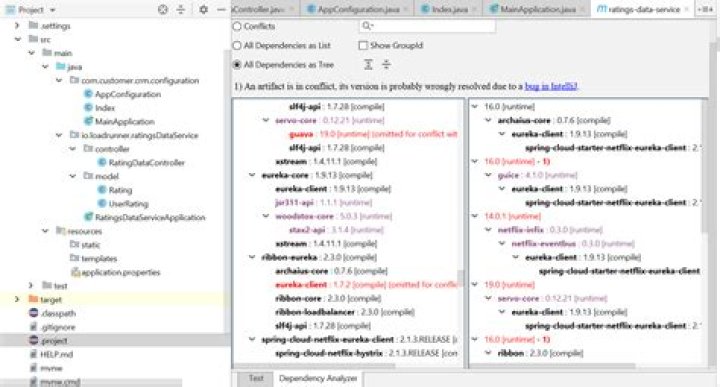
1I know this post is quite old, but still, if anyone using IntelliJ any want to see dependency tree directly in IDE then they can install Maven Helper Plugin plugin.
Once installed open pom.xml and you would able to see Dependency Analyze tab like below. It also provides option to see dependency that is conflicted only and also as a tree structure.
If you use a current version of m2eclipse (which you should if you use eclipse and maven):
Select the menu entry
Navigate -> Open Maven POM
and enter the artifact you are looking for.
The pom will open in the pom editor, from which you can select the tab Dependency Hierarchy to view the dependency hierarchy (as the name suggests :-) )
I created an online tool to do this. Simply paste any dependency in pom file format, and the dependency tree for that artifact is generated, based on the central maven repository.
When using IntelliJ, you have a one-click tool for Maven dependency exploration:
Results:
If your artifact is not a dependency of a given project, your best bet is to use a repository search engine. Many of them describes the dependencies of a given artifact.
3The for-artifact goal of the depgraph-maven-plugin should do what you want. To get a dependency graph of org.jboss.ws:jbossws-common-tools:1.3.2.Final you simply do
mvn com.github.ferstl:depgraph-maven-plugin:3.3.0:for-artifact -DgroupId=org.jboss.ws -DartifactId=jbossws-common-tools -Dversion=1.3.2.Final -DgraphFormat=text -DshowGroupIds=true -DshowVersions=true and you get
org.jboss.ws:jbossws-common-tools:1.3.2.Final:compile +- org.jboss.ws:jbossws-api:1.1.2.Final:compile +- org.apache.ant:ant:1.7.1:provided | \- org.apache.ant:ant-launcher:1.7.1:provided +- gnu.getopt:java-getopt:1.0.13:provided +- log4j:log4j:1.2.14:provided \- junit:junit:3.8.2:test without the need to create a Maven project or use and IDE or online app.
If you'd like to get a graphical, searchable representation of the dependency tree (including all modules from your project, transitive dependencies and eviction information), check out UpdateImpact: (free service).
Disclaimer: I'm one of the developers of the site
0