 $\begingroup$
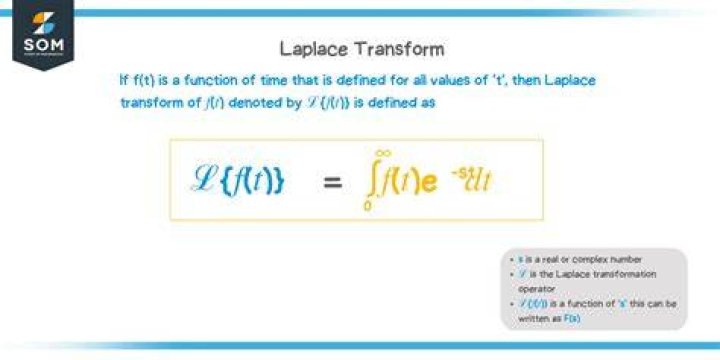
How to find the Laplace transform of the following function: $$f(t)=t e^t$$ $$F(s)=\int_0^\infty (te^t e^{-st})dt$$ What method do I use to find the integral?
$\endgroup$32 Answers
$\begingroup$We have: $$ f(t) = t e^t $$ So the Laplace transform of this function is: \begin{align*} F(s) &= \mathcal{L} \{ f(t) \} \\ &= \int_0^\infty f(t) e^{-st} \, dt \\ &= \int_0^\infty t e^{t} e^{-st} \, dt \\ &= \int_0^\infty t e^{(1-s)t} \, dt \\ &= \lim_{b \to \infty} \left[ \int_0^b t e^{(1-s)t} \, dt \right] \\ &= \lim_{b \to \infty} \left(\left[ t \cdot \frac{1}{1-s}e^{(1-s)t} \right]_{t=0}^b - \int_0^b \frac{1}{1-s}e^{(1-s)t} \, dt\right) \\ &= \frac{1}{1-s}\lim_{b \to \infty} \left(b e^{(1-s)b} - \int_0^b e^{(1-s)t} \, dt\right) \\ &= \frac{1}{s-1}\lim_{b \to \infty} \int_0^b e^{(1-s)t} \, dt & (s > 1) \\ &= \frac{1}{s-1}\lim_{b \to \infty} \left[\frac{1}{1-s} e^{(1-s)t} \right]_0^b & (s > 1) \\ &= \frac{1}{(s-1)^2}\lim_{b \to \infty} \left[1-e^{(1-s)b} \right] & (s > 1) \\ &= \frac{1}{(s-1)^2} & (s > 1) \end{align*}
$\endgroup$$\begingroup$To do it without integral (as in my comment in your other question), using properties of LT:
$$tf(t)\stackrel{\mathcal{L}}\longleftrightarrow-\frac{\mathrm d}{\mathrm ds}F(s)$$
Here $f(t)=e^t$ whose Laplace transform is $F(s)=\frac{1}{s-1}$.
The Laplace transform of $te^t$ becomes $$-\frac{\mathrm d}{\mathrm ds}\left(\frac{1}{s-1}\right)=\frac{1}{(s-1)^2}$$
$\endgroup$