 $\begingroup$
Find a basis for $R^3$ which contains a basis of $im(C)$ (image of C), where
$$C=\begin{pmatrix}1 & 2 & 3&4\\\ 2 & -4 & 6& -2\\ -1 & 2 & -3 &1 \end{pmatrix}$$
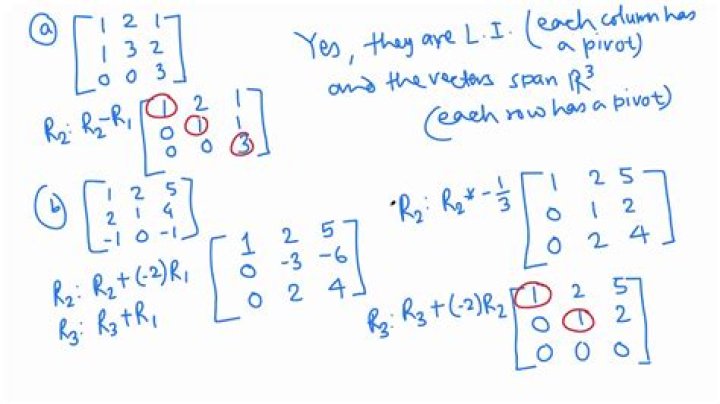
I managed to row-reduce the matrix to
$$C=\begin{pmatrix}1 & 2 & 3&4\\\ 0 & 8 & 0& 6\\ 0 & 0 & 0 &4 \end{pmatrix}$$
Therefore, a basis of $im(C)$ is given by the leading columns:
$$Basis = {\begin{pmatrix}1\\2\\-1 \end{pmatrix}, \begin{pmatrix}2\\-4\\2 \end{pmatrix}, \begin{pmatrix}4\\-2\\1 \end{pmatrix}}$$
However, what does the question mean by "Find a basis for $R^3$ which contains a basis of im(C)?According to the answers, one possible answer is:
{$\begin{pmatrix}1\\2\\-1 \end{pmatrix}, \begin{pmatrix}2\\-4\\2 \end{pmatrix}, \begin{pmatrix}0\\1\\0 \end{pmatrix}$}
$\endgroup$1 Answer
$\begingroup$You've made a calculation error, as the rank of your matrix is actually two, not three. If the rank of $C$ was three, you could have chosen any basis of $\mathbb{R}^3$ (not necessarily even consisting of some of the columns of $C$). But in your case, we have
$$ \begin{pmatrix} 3 \\ 6 \\ -3 \end{pmatrix} = 3 \begin{pmatrix} 1 \\ 2 \\ -1 \end{pmatrix}, \\ \begin{pmatrix} 4 \\ -2 \\ 1 \end{pmatrix} = \frac{3}{2} \begin{pmatrix} 1 \\ 2 \\ -1 \end{pmatrix} + \frac{5}{4} \begin{pmatrix} 2 \\ -4 \\ 2 \end{pmatrix}$$
so the last two columns depend linearly on the first two columns. To find a basis for $\mathbb{R}^3$ which contains a basis of $\operatorname{im}(C)$, choose any two linearly independent columns of $C$ such as the first two and add to them any third vector which is linearly independent of the chosen columns of $C$.
$\endgroup$2