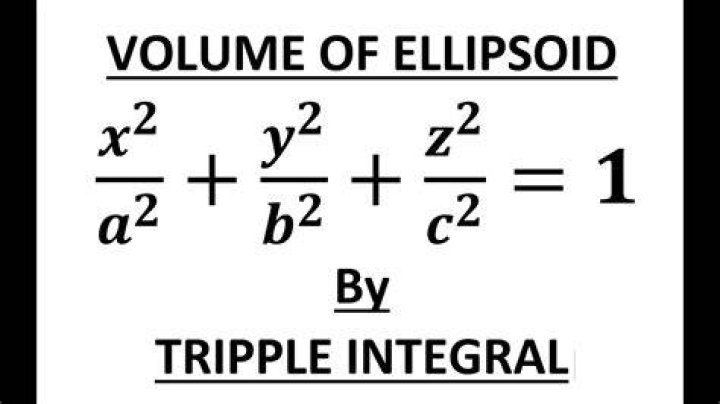
I'm having some troubles since this morning on an exercise. I need to find the volume of the ellipsoid defined by $\frac{x^2}{a^2} + \frac{y^2}{a^2} + \frac{z^2}{a^2} \leq 1$. So at the beginning I wrote $\left\{\begin{matrix} -a\leq x\leq a \\ -b\leq y\leq b \\ -c\leq z\leq c \end{matrix}\right.$
Then I wrote this as integral : $\int_{-c}^{c}\int_{-b}^{b}\int_{-a}^{a}1 dxdydz $.
I found as a result : $8abc$
But I knew it was incorrect. I browsed this website and many others for 2 hours and yeah I found that we need to express b and c in terms of x. But I don't know why.. Is there an intuitive way to understand that ? I have already done some double integral with b expressed in terms of a but I never figured out why..
$\endgroup$13 Answers
$\begingroup$If you are sticking with cartesian coordinates, then you will consider the points inside of the ellipsoid. The limits you wrote in your OP consider all points within $\pm a$,$\pm b$,$\pm c$ as @u8y7451 mentioned.
First, let's find our range of z.
$\frac{x^2}{a^2} + \frac{y^2}{b^2} + \frac{z^2}{c^2} \le 1$
$\frac{z^2}{c^2} \le 1- \frac{x^2}{a^2} - \frac{y^2}{b^2} $
$-c\sqrt{(1- \frac{x^2}{a^2} - \frac{y^2}{b^2})} \le z \le c\sqrt{(1- \frac{x^2}{a^2} - \frac{y^2}{b^2})}$
Next, we look at the projection of the ellipsoid onto the x-y plane.
$\frac{x^2}{a^2} + \frac{y^2}{b^2} \le 1$
This gives our value of y as a function of x.
$\frac{y^2}{b^2} \le 1 - \frac{x^2}{a^2}$
$-b\sqrt{(1 - \frac{x^2}{a^2})} \le y \le b\sqrt{(1 - \frac{x^2}{a^2})}$
$-a \le x \le a$
This should give you the proper ranges for your integrals as:
$\int\limits_{-a}^{a} \int_{-b\sqrt{1-x^2/a^2}}^{b\sqrt{1-x^2/a^2}}\int_{-c\sqrt{1-x^2/a^2 -y^2/b^2}}^{c\sqrt{1-x^2/a^2 -y^2/b^2}}1 dzdydx$
Apologies for the ugliness of that final formula.
EDIT: some further explanation.
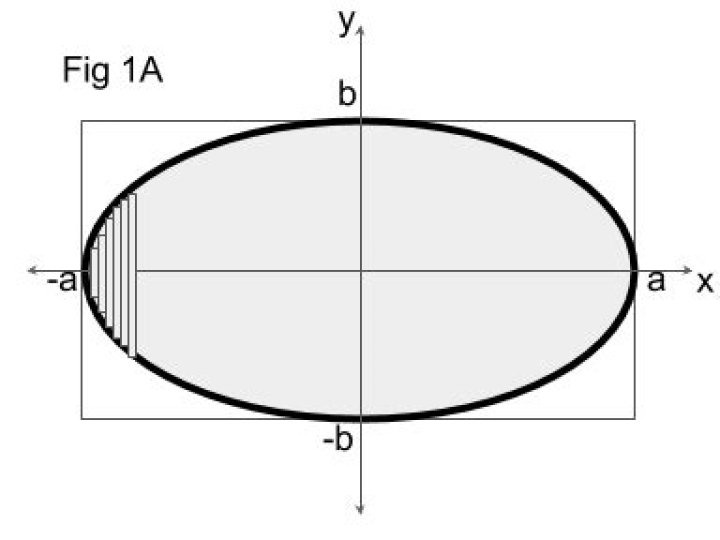
Suppose you would like to calculate the area inside of an ellipse centered at the origin, with vertices at $(\pm a,0)$ and $(0,\pm b)$ (see image). To do so, you need to decide what values of $(x,y)$ are inside. Clearly, the limits along the $x$-axis are $[-a,+a]$. So you could start at $x=-a$ and move to the right. Now, at each $x$, what values of $y$ are inside the ellipse? From the formula for an ellipse:
$\frac{x^2}{a^2} + \frac{y^2}{b^2} \le 1 \implies $
$-b\sqrt{(1 - \frac{x^2}{a^2})} \le y \le b\sqrt{(1 - \frac{x^2}{a^2})}$
Now, we could stop here, and calculate the area with a single integral:
$2b\int\limits_{-a}^{a}\sqrt{(1 - \frac{x^2}{a^2})}dx$. [eqn 1]
Effectively we are integrating the height of the ellipse by the width $dx$ (see Fig 1A). This is what most students are more familiar with.
Alternatively, we can go one more step, and instead of integrating columns, we integrate over tiny areas of width $dx$ and height $dy$, centered around each point within the ellipse (this is a little hand-wavy but hopefully Fig 1B makes it clearer). So as before, we start at $x=-a$ moving to the right, and for each x we start at the lower limit of $y$ moving up.
$\int\limits_{-a}^{a} \int_{-b\sqrt{1-x^2/a^2}}^{b\sqrt{1-x^2/a^2}}dydx$ [eqn 2]
The original problem just takes this one step further into the z-dimension.. Hope this helps!
$\endgroup$1$\begingroup$The easiest way to do this problem is to scale the axes by $a$, $b$, and $c$. That turns the ellipse into a sphere of radius $1$ and multiplies the volume by $1/abc$. So the volume of the ellipsoid is $abc$ times the volume of the unit sphere.
Of course that method doesn't give you any practice with triple integrals.
$\endgroup$$\begingroup$You can also use a modified spherical coordinate to describe the surface (not the interior) as \begin{align} x &=a \cos(v)\sin(u) \\ y &=b \sin(v)\sin(u) \\ z &=c \cos(u) \end{align} $0 \leq v < 2\pi$ and $0 \leq u \leq \pi$.
Then use the vector field $F=(0,0,z)$ and compute the outer flux through the surface. Note that the divergence of $F$ is $1$ hence by Divergence(Gauss) theorem it will be equal to the volume. But, surface integral is pretty easy.
$\endgroup$