 $\begingroup$
From Gilbert Strang's textbook Introduction to Linear Algebra (p.159)
Every matrix with full row rank has these properties
$Ax=b$ has a solution for every right side $b$.
The column space is the whole space $R^m$.
Given that the matrix $A$(of dimensions $m \times n$) is full row-rank, all we know is that it has at least $(n-m)$ non-pivot variables. Therefore, $Ax=b$ has infinite solutions. But does infinite solutions imply $1$ or $2$ above (both are equivalent) ?
How does full row rank imply column space is $R^m$ for a $m \times n$ matrix ?
$\endgroup$1 Answer
$\begingroup$Let $A = [c_1\ \cdots\ c_n]$ where $c_1, \dots, c_n \in \mathbb{R}^m$ are the columns of $A$.
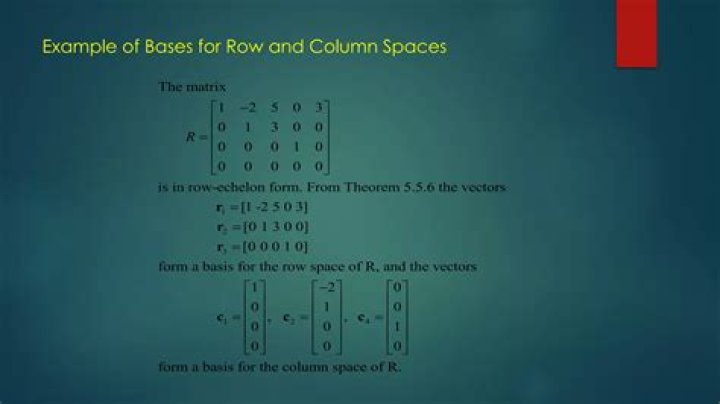
If $A$ has full row rank, then there are $m$ rows which have a pivot in them when $A$ is in reduced row echelon form. Now consider the columns which have pivots in them, again there are $m$ of them (no two pivots can be in the same column). Let $c_{i_1}, \dots, c_{i_m}$ be the corresponding columns of $A$ (i.e. the columns which have a pivot when in row reduced echelon form). Then $\{c_{i_1}, \dots, c_{i_m}\}$ is a linearly independent subset of $\mathbb{R}^m$, but as it contains $m$ vectors, it also spans $\mathbb{R}^m$ (as explained here).
Therefore $\operatorname{Col}(A) = \operatorname{span}\{c_1, \dots, c_n\} \supseteq \operatorname{span}\{c_{i_1}, \dots, c_{i_m}\} = \mathbb{R}^m$, so the column space of $A$ is $\mathbb{R}^m$.
$\endgroup$2