
I have a small script that performs the build and install process on Windows for a Bazaar repository I'm managing. I'm trying to run the script with elevated, administrative privileges from within the Windows shell (cmd.exe)--just as if I'd right-clicked it and chosen Run as Administrator, but without using any method that requires use of the graphical interface.
212 Answers
Press the start button. In the search box type "cmd", then press Ctrl+Shift+Enter
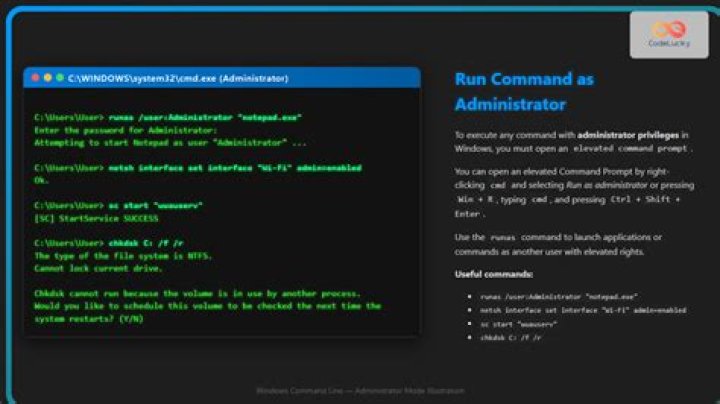
2All you have to do is use the runas command to run your program as Administrator (with a caveat).
runas /user:Administrator "cmdName parameters" In my case, this was
runas /user:Administrator "cmd.exe /C %CD%\installer.cmd %CD%" Note that you must use Quotation marks, else the runas command will gobble up the switch option to cmd.
Also note that the administrative shell (cmd.exe) starts up in the C:\Windows\System32 folder. This isn't what I wanted, but it was easy enough to pass in the current path to my installer, and to reference it using an absolute path.
Caveat: Enable the admin account
Using runas this way requires the administrative account to be enabled, which is not the default on Windows 7 or Vista. However, here is a great tutorial on how to enable it, in three different ways:
I myself enabled it by opening Administrative Tools, Local Security Policy, then navigating to Local Policies\Security Options and changing the value of the Accounts: Administrative Account Status policy to Enabled, which is none of the three ways shown in the link.
An even easier way to accomplish this:
C:> net user Administrator /active:yes A batch/WSH hybrid is able to call ShellExecute to display the UAC elevation dialog...
@if (1==1) @if(1==0) @ELSE @echo off&SETLOCAL ENABLEEXTENSIONS >nul 2>&1 "%SYSTEMROOT%\system32\cacls.exe" "%SYSTEMROOT%\system32\config\system"||( cscript //E:JScript //nologo "%~f0" @goto :EOF ) echo.Performing admin tasks... REM call foo.exe @goto :EOF @end @ELSE ShA=new ActiveXObject("Shell.Application") ShA.ShellExecute("cmd.exe","/c \""+WScript.ScriptFullName+"\"","","runas",5); @end :: ------- Self-elevating.bat -------------------------------------- @whoami /groups | find "S-1-16-12288" > nul && goto :admin set "ELEVATE_CMDLINE=cd /d "%~dp0" & call "%~f0" %*" findstr "^:::" "%~sf0">temp.vbs cscript //nologo temp.vbs & del temp.vbs & exit /b ::: Set objShell = CreateObject("Shell.Application") ::: Set objWshShell = WScript.CreateObject("WScript.Shell") ::: Set objWshProcessEnv = objWshShell.Environment("PROCESS") ::: strCommandLine = Trim(objWshProcessEnv("ELEVATE_CMDLINE")) ::: objShell.ShellExecute "cmd", "/c " & strCommandLine, "", "runas" :admin ------------------------------------------------------------- @echo off echo Running as elevated user. echo Script file : %~f0 echo Arguments : %* echo Working dir : %cd% echo. :: administrator commands here :: e.g., run shell as admin cmd /k For a demo: self-elevating.bat "path with spaces" arg2 3 4 "another long argument"
And this is another version that does not require creating a temp file.
<!-- : --- Self-Elevating Batch Script --------------------------- @whoami /groups | find "S-1-16-12288" > nul && goto :admin set "ELEVATE_CMDLINE=cd /d "%~dp0" & call "%~f0" %*" cscript //nologo "%~f0?.wsf" //job:Elevate & exit /b --> <job><script language="VBScript"> Set objShell = CreateObject("Shell.Application") Set objWshShell = WScript.CreateObject("WScript.Shell") Set objWshProcessEnv = objWshShell.Environment("PROCESS") strCommandLine = Trim(objWshProcessEnv("ELEVATE_CMDLINE")) objShell.ShellExecute "cmd", "/c " & strCommandLine, "", "runas" </script></job> :admin ----------------------------------------------------------- @echo off echo Running as elevated user. echo Script file : %~f0 echo Arguments : %* echo Working dir : %cd% echo. :: administrator commands here :: e.g., run shell as admin cmd /k Although @amr ali's code was great, I had an instance where my bat file contained > < signs, and it choked on them for some reason.
I found this instead. Just put it all before your code, and it works perfectly.
REM --> Check for permissions >nul 2>&1 "%SYSTEMROOT%\system32\cacls.exe" "%SYSTEMROOT%\system32\config\system" REM --> If error flag set, we do not have admin. if '%errorlevel%' NEQ '0' ( echo Requesting administrative privileges... goto UACPrompt ) else ( goto gotAdmin ) :UACPrompt echo Set UAC = CreateObject^("Shell.Application"^) > "%temp%\getadmin.vbs" echo UAC.ShellExecute "%~s0", "", "", "runas", 1 >> "%temp%\getadmin.vbs" "%temp%\getadmin.vbs" exit /B :gotAdmin if exist "%temp%\getadmin.vbs" ( del "%temp%\getadmin.vbs" ) pushd "%CD%" CD /D "%~dp0" :-------------------------------------- I would set up a shortcut, either to CMD or to the thing you want to run, then set the properties of the shortcut to require admin, and then run the shortcut from your batch file. I haven't tested to confirm it will respect the properties, but I think it's more elegant and doesn't require activating the Administrator account.
Also if you do it as a scheduled task (which can be set up from code) there is an option to run it elevated there.
2Simple pipe trick, ||, with some .vbs used at top of your batch. It will exit regular and restart as administrator.
@AT>NUL||echo set shell=CreateObject("Shell.Application"):shell.ShellExecute "%~dpnx0",,"%CD%", "runas", 1:set shell=nothing>%~n0.vbs&start %~n0.vbs /realtime& timeout 1 /NOBREAK>nul& del /Q %~n0.vbs&cls&exit It also del /Q the temp.vbs when it's done using it.
Browse to C:\windows\System32 and right click on cmd.exe and run as Administrator. Worked for me on Windows 7.
If you are trying to run a script with elevated privileges you could do the same for the script file or use the scheduler's run as a different user option to run the script.
1i just created an shortcut in my desktop with this line in target:
C:\Windows\System32\WindowsPowerShell\v1.0\powershell.exe -command Start-Process -verb RunAs wt and after pinned in taskbar :)
1NirCmd offers elevated Use nircmdc
You can call PowerShell via its CLI, powershell.exe, in order to call its Start-Process cmdlet, which supports starting processes with elevation; doing so has two advantages:
You don't need a hybrid batch file that uses clever, but obscure tricks to combine the languages of two distinct environments in a single file.
You may place
-Waitbefore-Verb RunAs(see below) in order to make the elevated reinvocation synchronous, i.e. to wait for it to exit and communicate its exit code to the caller.
The following borrows techniques from Amr Ali's helpful WSH-assisted answer; save and run as run-elevated.cmd, for instance:
@echo off & setlocal :: Check if the current session is already elevated. :: `net session` only succeeds in elevated sessions. net session >NUL 2>&1 && goto :ELEVATED :: Getting here means that we must reinvoke with elevation. :: Add -Wait before -Verb RunAs to wait for the reinvocation to exit. set ELEVATE_CMDLINE=cd /d "%~dp0" ^& "%~f0" %* powershell.exe -noprofile -c Start-Process -Verb RunAs cmd.exe \"/k $env:ELEVATE_CMDLINE\" exit /b %ERRORLEVEL% :: Getting here means that we are (now) running with elevation. :ELEVATED echo === Running in elevated session: echo Script file : %~f0 echo Arguments : %* echo Working dir : %cd% Speaking of Amr Ali's WSH-assisted answer; here is a reformulation that makes passing the arguments through more robust, so that arguments such as "a & b" may be passed, and prevents duplicating "^" characters in arguments by avoiding the use of call - see line set ELEVATE_CMDLINE=...; also, apart from some formatting for readability, it is ensured that none of the original batch statements are accidentally echoed:
<!-- : (":" is required) @echo off & setlocal net session >NUL 2>&1 && goto :ELEVATED set ELEVATE_CMDLINE=cd /d "%~dp0" ^& "%~f0" %* cscript.exe //nologo "%~f0?.wsf" //job:Elevate & exit /b --> <job> <script language="VBScript"> Set objShell = CreateObject("Shell.Application") Set objWshShell = WScript.CreateObject("WScript.Shell") Set objWshProcessEnv = objWshShell.Environment("PROCESS") strCommandLine = Trim(objWshProcessEnv("ELEVATE_CMDLINE")) objShell.ShellExecute "cmd", "/k " & strCommandLine, "", "runas" </script> </job> :ELEVATED echo === Running in elevated session: echo Script file: %~f0 echo Arguments : %* echo Working dir: %cd% I personally did not satisfied with any of suggested solutions so I traced and find out how microsoft itself is running some commands as administrator without any confirmations.
Here is what I finally found from windows registry:
*RunAs "D:\Path\To\app.exe" *RunAs "D:\Path\To\app.exe" [YourCommandArgs]