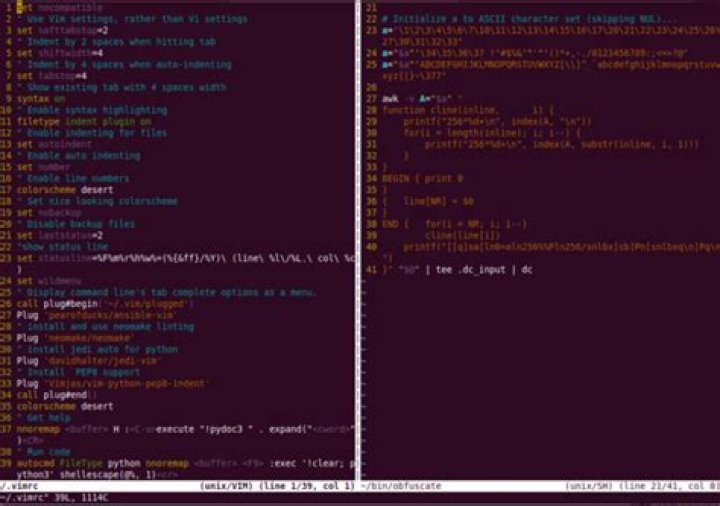

Can you edit your .vimrc file and reload it without having to restart Vim?
5 Answers
If you're editing it, you can reload it with:
:so % % stands for current file name (see :h current-file) and :so is short for :source, which reads the content of the specified file and treats it as Vim code.
In general, to re-load the currently active .vimrc, use the following (see Daily Vim):
:so $MYVIMRC Even better, you configure Vim to watch for changes in your .vimrc and automatically reload the config.
augroup myvimrc au! au BufWritePost .vimrc,_vimrc,vimrc,.gvimrc,_gvimrc,gvimrc so $MYVIMRC | if has('gui_running') | so $MYGVIMRC | endif augroup END Source: this answer on SO
Note: this particular method watches for the many variations of Vim config filenames so that it's compatible with GUI Vim, Windows Vim, etc.
2Key mappings
" Quickly edit/reload this configuration file nnoremap gev :e $MYVIMRC<CR> nnoremap gsv :so $MYVIMRC<CR> Completely automated solution
To automatically reload upon save, add the following to your $MYVIMRC:
if has ('autocmd') " Remain compatible with earlier versions augroup vimrc " Source vim configuration upon save autocmd! BufWritePost $MYVIMRC source % | echom "Reloaded " . $MYVIMRC | redraw autocmd! BufWritePost $MYGVIMRC if has('gui_running') | so % | echom "Reloaded " . $MYGVIMRC | endif | redraw augroup END endif " has autocmd and then for the last time, type:
:so % The next time you save your vimrc, it will be automatically reloaded.
Features:
- Tells the user what has happened (also logging to
:messages) - Handles various names for the configuration files
- Ensures that it wil only match the actual configuration file (ignores copies in other directories, or a
fugitive://diff) - Won't generate an error if using
vim-tiny
Of course, the automatic reload will only happen if you edit your vimrc in vim.
An alternative to remembering/typing :so $MYVIMRC is these mappings. It lets you quickly edit vimrc (ev) or source vimrc (sv).
" Quickly open/reload vim nnoremap <leader>ev :split $MYVIMRC<CR> nnoremap <leader>sv :source $MYVIMRC<CR> I have a slightly different version of ReloadVimrcFunction
" Reloads vimrc after saving it but keep cursor position if !exists('*ReloadVimrcFunction') function! ReloadVimrcFunction() let save_cursor = getcurpos() source $MYVIMRC | windo redraw call setpos('.', save_cursor) echom "Reloaded $MYVIMRC" endfunction endif noremap <silent> <Leader>v :drop $MYVIMRC<cr> command! -nargs=0 ReloadVimrc :call ReloadVimrcFunction() nnoremap <silent> <C-s> :call ReloadVimrcFunction()<CR> In order to avoid loading the function twice we set:
if !exists('*ReloadVimrcFunction') We also save the cursor position because it would be anoying to have our cursor positioning changing every time we reload $MYVIMRC.
I also have an augroup to trigger this function each time I save $MYVIMRC
augroup Reload autocmd! autocmd BufWritePost $MYVIMRC call ReloadVimrcFunction() augroup END