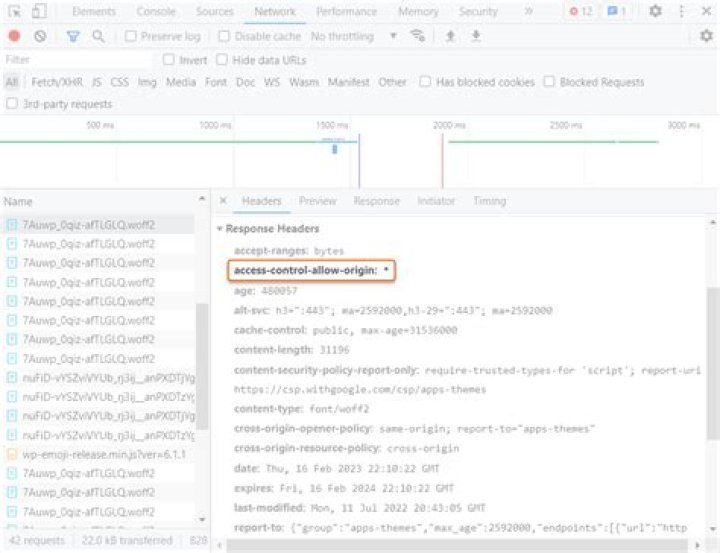

I've been reading about Access-Control-Allow-Origin because it seems effective at allowing cross domain requests since I have access to the external site. My question ism how do I use Access-Control-Allow-Origin to allow cross domain requests. I tried this (don't laugh) (by the way all I want is for a single number, 1 or 0 to be returned)
<html> <head> Access-Control-Allow-Origin: * </head> <body> 1 </body> </html> Am I close? Thanks for your help. If there is an easier way to do a simple cross-domain request let me know.
14 Answers
There are 3 ways to allow cross domain origin (excluding jsonp):
Set the header in the page directly using a templating language like PHP. Keep in mind there can be no HTML before your header or it will fail.
Modify the server configuration file (
apache.conf) and add this line. Note that"*"represents allow all. Some systems might also need the credential set. In general allow all access is a security risk and should be avoided:Header set Access-Control-Allow-Origin "*" Header set Access-Control-Allow-Credentials true
To allow multiple domains on Apache web servers add the following to your config file
SetEnvIf Origin "http(s)?://(www\.)?(example.org|example.com)$" AccessControlAllowOrigin=$0$1 Header add Access-Control-Allow-Origin %{AccessControlAllowOrigin}e env=AccessControlAllowOrigin Header set Access-Control-Allow-Credentials trueFor development use only hack your browser and allow unlimited CORS using the Chrome Allow-Control-Allow-Origin extension
Disable CORS in Chrome: Quit Chrome completely. Open a terminal and execute the following. Just be cautious you are disabling web security:
open -a Google\ Chrome --args --disable-web-security --user-data-dir
That is an HTTP header. You would configure your webserver or webapp to send this header ideally. Perhaps in htaccess or PHP.
Alternatively you might be able to use
<head>...<meta http-equiv="Access-Control-Allow-Origin" content="*">...</head> I do not know if that would work. Not all HTTP headers can be configured directly in the HTML.
This works as an alternative to many HTTP headers, but see @EricLaw's comment below. This particular header is different.
Caveat
This answer is strictly about how to set headers. I do not know anything about allowing cross domain requests.
About HTTP Headers
Every request and response has headers. The browser sends this to the webserver
GET /index.htm HTTP/1.1 Then the headers
Host: User-Agent: (Browser/OS name and version information) .. Additional headers indicating supported compression types and content types and other info Then the server sends a response
Content-type: text/html Content-length: (number of bytes in file (optional)) Date: (server clock) Server: (Webserver name and version information) Additional headers can be configured for example Cache-Control, it all depends on your language (PHP, CGI, Java, htaccess) and webserver (Apache, etc).
<?php header("Access-Control-Allow-Origin: "); ?> This command disables only first console warning info
Result: console result
If you use Java and spring MVC you just need to add the following annotation to your method returning your page :
@CrossOrigin(origins = "*") "*" is to allow your page to be accessible from anywhere. See for more details about that.