 $\begingroup$
Find the self-adjoint form of the ODE : $ x^2y''+xy'+\mu y=0 \ $ in the form
$ \frac{d}{dx} [p_0 (x) y']+ \mu [q_0(x)]y=0 \ $
Answer:
The adjoint equation is
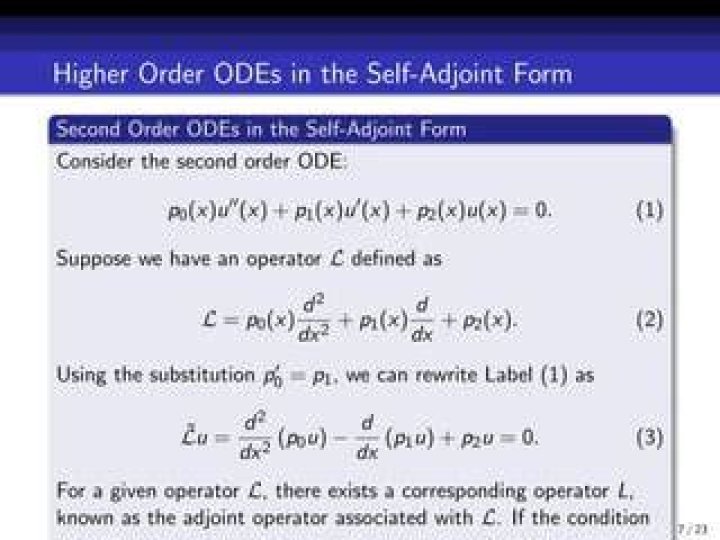
$ \frac{d^2}{dx^2}(x^2y)-\frac{d}{dx}(xy)+\mu y=0 \\ or, \ (2y+2xy'+x^2y''+2xy)-y-xy'+\mu y=0 \\ or, \ x^2 y''+(2x-x)y'+(1+ \mu+2x)y=0 $
But how can I put it in the above form given in the question ?
$\endgroup$2 Answers
$\begingroup$Divide by $x$ and find $$ (xy'(x))'+\frac{μ}{x}y(x)=0. $$ In general, you compute the derivatives in the self-adjoint form and then compare coefficients, $$ (py')'+qy=py''+p'y'+qy $$ so that for the one equation to be a multiple of the other, one needs to have $$ \frac{p(x)}{x^2}=\frac{p'(x)}{x}, $$ which again solves to $p(x)=cx$ where you can take $c=1$.
$\endgroup$2$\begingroup$$$x^2y''+xy'+\mu y=0$$ $\frac{d}{dx}(x^2y')=x^2y''+2xy'\quad\to\quad x^2y''=\frac{d}{dx}(x^2y')-2xy'$ $$\left(\frac{d}{dx}(x^2y')-2xy`\right)+xy'+\mu y=0$$ $$\frac{d}{dx}(x^2y')-xy`+\mu y=0$$ $\frac{d}{dx}(xy)=xy'+y\quad\to\quad xy'=\frac{d}{dx}(xy)-y$ $$\frac{d}{dx}(x^2y')-\left(\frac{d}{dx}(xy)-y \right)+\mu y=0$$ $\frac{d}{dx}(x^2y')-\frac{d}{dx}(xy) +(1+\mu) y=0$ $$\frac{d}{dx}(x^2y'-xy) +(1+\mu) y=0$$
$\endgroup$