 $\begingroup$
A geometric series has a first term $\sqrt{2}$ and a second term $\sqrt{6}$ . Find the 12th term and the sum of the first 12 terms.
I can get to the answers as irrational numbers using a calculator but how can I can obtain the two answers in radical form $243 * \sqrt{6}$ and $364 \left(\sqrt{6}+\sqrt{2}\right)$ ?
The closest I get with the 12th term is $\sqrt{2} \left(\sqrt{6} \over \sqrt{2}\right)^{(12-1)}$ or $\sqrt{2} * 3^\left({11\over 2}\right)$
And for the sum ${\sqrt{2}-\sqrt{2}*(\sqrt{3})^{12} \over 1 - \sqrt{3}}$
$\endgroup$12 Answers
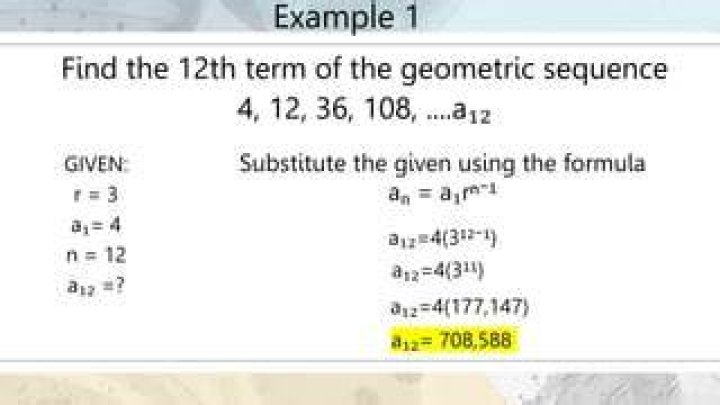
$\begingroup$The general term of a geometric series is $a r^{n-1}$, where $r$ is the ratio, and $a$ is the first term. In your case, $a=\sqrt{2}$ and $r=\sqrt{3}$. The 12th term is then
$$\sqrt{2} (\sqrt{3})^{11} = 243 \sqrt{6}$$
The sum of the first 12 terms is
$$a \sum_{k=0}^{11} r^k = a \frac{r^{12}-1}{r-1} = \sqrt{2} \frac{728}{\sqrt{3}-1} = 364 (\sqrt{2}+\sqrt{6})$$
Note that I used $3^5 = 243$ and $3^6=729$ in the above.
EDIT
Note that
$$ \sqrt{2} \frac{728}{\sqrt{3}-1} = \sqrt{2} \frac{728}{\sqrt{3}-1} \frac{\sqrt{3}+1}{\sqrt{3}+1} = \frac{\sqrt{2} (\sqrt{3}+1) 728}{(\sqrt{3})^2-1^2} = \frac{(\sqrt{6}+\sqrt{2}) 728}{3-1}$$
$\endgroup$2$\begingroup$So, the common ratio $=\frac{\sqrt6}{\sqrt2}=\sqrt3$
So, the $n$ th term $=\sqrt2(\sqrt3)^{n-1}\implies 12$th term $=\sqrt2(\sqrt3)^{12-1}=\sqrt2(\sqrt3)^{11}$
Now, $\displaystyle(\sqrt3)^{11}=\sqrt3 \cdot 3^5=243\sqrt3$
The sum of $n$ term is $\displaystyle \sqrt2\cdot\frac{(\sqrt3)^n-1}{\sqrt3-1}$
$\implies 12$th term $=\displaystyle \sqrt2\cdot\frac{(\sqrt3)^{12}-1}{\sqrt3-1}=\sqrt2\cdot\frac{(3^6-1)(\sqrt3+1)}{(\sqrt3-1)(\sqrt3+1)}$ (rationalizing the denominator )
$\displaystyle=\frac{(3^3-1)(3^3+1)\sqrt2(\sqrt3+1)}2=364(\sqrt6+\sqrt2)$
$\endgroup$