Previously answered questions here said that this was the fastest way:
//nl is a NodeList var arr = Array.prototype.slice.call(nl); In benchmarking on my browser I have found that it is more than 3 times slower than this:
var arr = []; for(var i = 0, n; n = nl[i]; ++i) arr.push(n); They both produce the same output, but I find it hard to believe that my second version is the fastest possible way, especially since people have said otherwise here.
Is this a quirk in my browser (Chromium 6)? Or is there a faster way?
EDIT: For anyone who cares, I settled on the following (which seems to be the fastest in every browser that I tested):
//nl is a NodeList var l = []; // Will hold the array of Node's for(var i = 0, ll = nl.length; i != ll; l.push(nl[i++])); EDIT2: I found an even faster way
// nl is the nodelist var arr = []; for(var i = nl.length; i--; arr.unshift(nl[i])); 14 Answers
With ES6, we now have a simple way to create an Array from a NodeList: the Array.from() function.
// nl is a NodeList let myArray = Array.from(nl) 2021 update: nodeList.forEach() is now standard and supported in all current browsers (around 95% on both desktop & mobile).
So you can simply do:
document.querySelectorAll('img').forEach(highlight); Other cases
If you for some reason want to convert it to an array, not just iterate over it - which is a completely relevant use-case - you can use [...destructuring] or Array.from since ES6
let array1 = [...mySetOfElements]; // or let array2 = Array.from(mySetOfElements); This also works for other array-like structures that aren't NodeLists
HTMLCollectionreturned by e.g.document.getElementsByTagName- objects with a length property and indexed elements
- iterable objects (objects such as
MapandSet)
Outdated 2010 Answer
The second one tends to be faster in some browsers, but the main point is that you have to use it because the first one is just not cross-browser. Even though The Times They Are a-Changin'
@kangax (IE 9 preview)
Array.prototype.slice can now convert certain host objects (e.g. NodeList’s) to arrays — something that majority of modern browsers have been able to do for quite a while.
Example:
Array.prototype.slice.call(document.childNodes); Here's a new cool way to do it using the ES6 spread operator:
let arr = [...nl]; In ES6 you can either use:
Array.from
let array = Array.from(nodelist)Spread operator
let array = [...nodelist]
Some optimizations:
- save the NodeList's length in a variable
- explicitly set the new array's length before setting.
- access the indices, rather than pushing or unshifting.
Code (jsPerf):
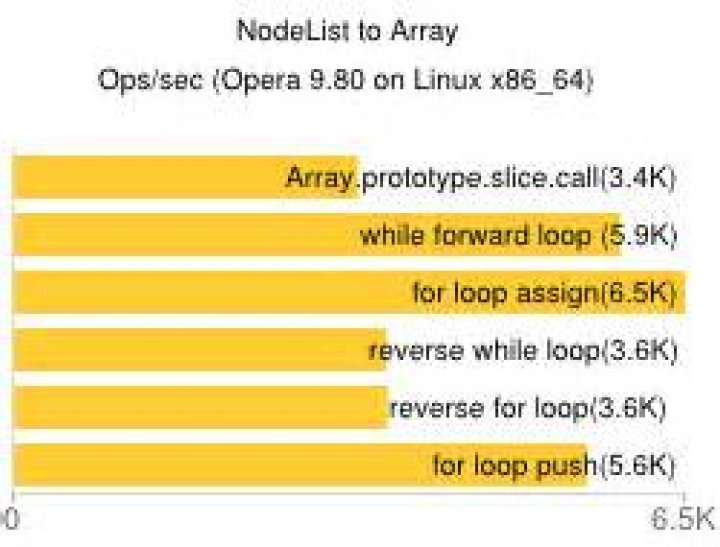
var arr = []; for (var i = 0, ref = arr.length = nl.length; i < ref; i++) { arr[i] = nl[i]; } The results will completely depend on the browser, to give an objective verdict, we have to make some performance tests, here are some results, you can run them here:
Chrome 6:

Firefox 3.6:
Firefox 4.0b2:
Safari 5:
IE9 Platform Preview 3:
The most fast and cross browser is
for(var i=-1,l=nl.length;++i!==l;arr[i]=nl[i]); As I compared in
*Thanks @CMS for the idea!



Assuming nodeList = document.querySelectorAll("div"), this is a concise form of converting nodelist to array.
var nodeArray = [].slice.call(nodeList); See me use it here.
NodeList.prototype.forEach = Array.prototype.forEach; Now you can do document.querySelectorAll('div').forEach(function()...)
3faster and shorter :
// nl is the nodelist var a=[], l=nl.length>>>0; for( ; l--; a[l]=nl[l] ); Check out this blog post here that talks about the same thing. From what I gather, the extra time might have to do with walking up the scope chain.
2This is the function I use in my JS:
function toArray(nl) { for(var a=[], l=nl.length; l--; a[l]=nl[l]); return a; } Here are charts updated as of the date of this posting ("unknown platform" chart is Internet Explorer 11.15.16299.0):



From these results, it seems that the preallocate 1 method is the safest cross-browser bet.
The simplest way:
Array.from(document.querySelectorAll('.back-top'))