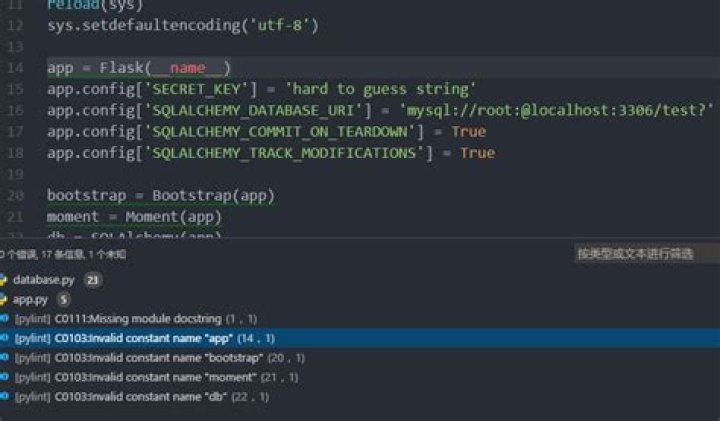
I'm confused about the error(s) in this photo:
I don't know how to fix them. My program is a Python-Flask web frame. When I use Visual Studio Code to debug my program, Pylint shows these errors. I know this problem doesn't matter, but it makes me annoyed. How can I fix it?
# -*- coding: utf-8 -*- import sys from flask import Flask from flask_bootstrap import Bootstrap from flask_moment import Moment #from flask_wtf import Form #from wtforms import StringField, SubmitField #from wtforms.validators import Required from flask_sqlalchemy import SQLAlchemy reload(sys) sys.setdefaultencoding('utf-8') app = Flask(__name__) app.config['SECRET_KEY'] = 'hard to guess string' app.config['SQLALCHEMY_DATABASE_URI'] = 'mysql://root:@localhost:3306/test?' app.config['SQLALCHEMY_COMMIT_ON_TEARDOWN'] = True app.config['SQLALCHEMY_TRACK_MODIFICATIONS'] = True bootstrap = Bootstrap(app) moment = Moment(app) db = SQLAlchemy(app) if __name__ == '__main__': db.create_all() app.run() 5 Answers
As explained by Kundor, PEP 8 states that:
Constants are usually defined on a module level and written in all capital letters with underscores separating words.
The point is that "constants" in Python don't really exist. Pylint, as per PEP 8, expects module level variables to be "constants."
That being said you've several options:
you don't want this "constant" thing, then change Pylint's
const-rgxregular expression to be the same as e.g.variable-rgx,you may deactivate those warnings for this file, or even locally in the file, using
# pylint: disable=invalid-name,avoid module level variables, by wrapping them into a function.
In your case, I would go with the third option, by creating a build_app function or something similar. That would return the application (and maybe the 'db' object as well, but you have several choices there). Then you could add a salt of the second option to get something like:
app = build_app() # pylint: disable=invalid-name
The fact that PEP 8 considers only constants at the module level is probably the reason why many developers use a dedicated main() function.
So you could solve your problem like this:
def main(): app = Flask(__name__) app.config['SECRET_KEY'] = 'hard to guess string' app.config['SQLALCHEMY_DATABASE_URI'] = 'mysql://root:@localhost:3306/test?' app.config['SQLALCHEMY_COMMIT_ON_TEARDOWN'] = True app.config['SQLALCHEMY_TRACK_MODIFICATIONS'] = True bootstrap = Bootstrap(app) moment = Moment(app) db = SQLAlchemy(app) db.create_all() app.run() if __name__ == '__main__': main() PEP 8 decrees that names of constants should be in all caps.
So, rename those variables to be all caps.
Tip: if you google 'C0103' it'll take you to the Pylint messages wiki entry for that message, with details on it.
1Rename those variables to be all caps.
Such as
app = Flask(__name__) => APP = Flask(__name__) bootstrap = Bootstrap(app) => BOOTSTRAP = Bootstrap(app) You can use the following line at the beginning of your Python script and execute it:
# pylint: disable=invalid-name It will disable all the invalid constant convention messages in the static code analyzer.
1