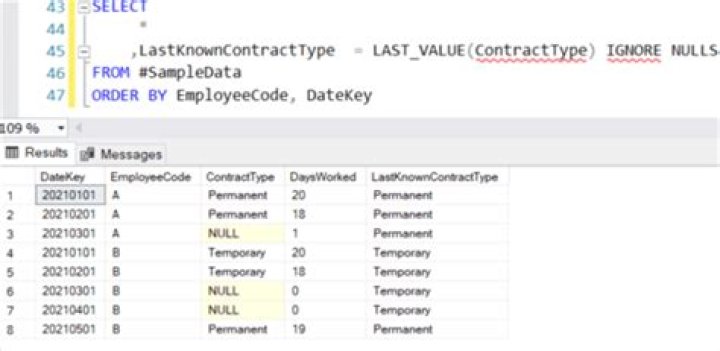
I want to find a way to get the last non-null value for a purchase of a user. For example, I have this:
date | user_id | purchase_amount 2020-01-01 | 1 | 39 2020-01-04 | 1 | null 2020-01-10 | 1 | 90 2020-01-15 | 1 | null I want if to fill in the following way:
date | user_id | purchase_amount 2020-01-01 | 1 | 39 2020-01-04 | 1 | 39 2020-01-10 | 1 | 90 2020-01-15 | 1 | 90 Right now, I am using a LEAD function partition by user_id but it still would consider even non-null values. How to approach this?
1 Answer
As a disclaimer, this answer is largely based on the excellent accepted answer to this SO question. This answer creates a pseudo-group for each block of records which should ultimately be assigned the same purchase amount. It then uses the FIRST_VALUE() function, which should be available on Redshift, to fill in the null gaps.
WITH cte AS ( SELECT *, SUM(CASE WHEN purchase_amount IS NULL THEN 0 ELSE 1 END) OVER (PARTITION BY user_id ORDER BY date) AS grp FROM yourTable ) SELECT date, user_id, FIRST_VALUE(purchase_amount) OVER (PARTITION BY grp, user_id ORDER BY date) AS purchase_amount FROM cte ORDER BY user_id, date; 
Note that the demo is for Postgres, but the code should also run on Redshift with no modification necessary.