
I'm trying to download winamp's website in case they shut it down. I need to download literally everything.
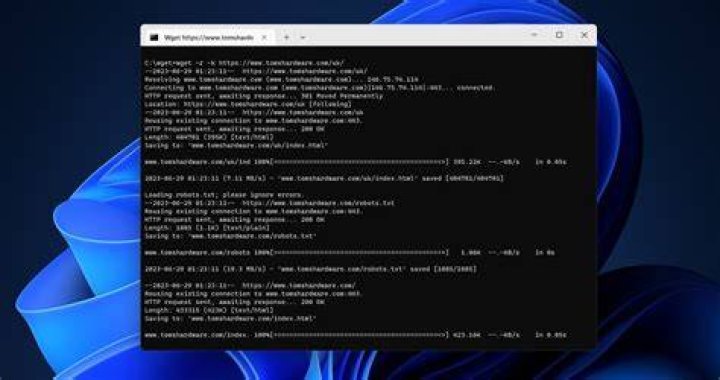
I tried once with wget and I managed to download the website itself, but when I try to download any file from it it gives a file without an extension or name. How can I fix that?
5 Answers
You may need to mirror the website completely, but be aware that some links may really dead. You can use HTTrack or wget:
wget -r # or whatever With HTTrack, first install it:
sudo apt-get install httrack now run it just 1 external link:
httrack --ext-depth=1 This will download the winapp CDN files, but not the files in the files in the files in the whole internet.
0wget -p -k From man wget
-p --page-requisites This option causes Wget to download all the files that are necessary to properly display a given HTML page. This includes such things as inlined images, sounds, and referenced stylesheets. Ordinarily, when downloading a single HTML page, any requisite documents that may be needed to display it properly are not downloaded. Using -r together with -l can help, but since Wget does not ordinarily distinguish between external and inlined documents, one is generally left with "leaf documents" that are missing their requisites. For instance, say document 1.html contains an "<IMG>" tag referencing 1.gif and an "<A>" tag pointing to external document 2.html. Say that 2.html is similar but that its image is 2.gif and it links to 3.html. Say this continues up to some arbitrarily high number. If one executes the command: wget -r -l 2 then 1.html, 1.gif, 2.html, 2.gif, and 3.html will be downloaded. As you can see, 3.html is without its requisite 3.gif because Wget is simply counting the number of hops (up to 2) away from 1.html in order to determine where to stop the recursion. However, with this command: wget -r -l 2 -p all the above files and 3.html's requisite 3.gif will be downloaded. Similarly, wget -r -l 1 -p will cause 1.html, 1.gif, 2.html, and 2.gif to be downloaded. One might think that: wget -r -l 0 -p would download just 1.html and 1.gif, but unfortunately this is not the case, because -l 0 is equivalent to -l inf---that is, infinite recursion. To download a single HTML page (or a handful of them, all specified on the command-line or in a -i URL input file) and its (or their) requisites, simply leave off -r and -l: wget -p Note that Wget will behave as if -r had been specified, but only that single page and its requisites will be downloaded.Links from that page to external documents will not be followed. Actually, to download a single page and all its requisites (even if they exist on separate websites), and make sure the lot displays properly locally, this author likes to use a few options in addition to -p: wget -E -H -k -K -p To finish off this topic, it's worth knowing that Wget's idea of an external document link is any URL specified in an "<A>" tag, an "<AREA>" tag, or a "<LINK>" tag other than "<LINK REL="stylesheet">". ================================================================== -k --convert-links After the download is complete, convert the links in the document to make them suitable for local viewing. This affects not only the visible hyperlinks, but any part of the document that links to external content, such as embedded images, links to style sheets, hyperlinks to non-HTML content, etc. Each link will be changed in one of the two ways: · The links to files that have been downloaded by Wget will be changed to refer to the file they point to as a relative link. Example: if the downloaded file /foo/doc.html links to /bar/img.gif, also downloaded, then the link in doc.html will be modified to point to ../bar/img.gif. This kind of transformation works reliably for arbitrary combinations of directories. · The links to files that have not been downloaded by Wget will be changed to include host name and absolute path of the location they point to. Example: if the downloaded file /foo/doc.html links to /bar/img.gif (or to ../bar/img.gif), then the link in doc.html will be modified to point to Because of this, local browsing works reliably: if a linked file was downloaded, the link will refer to its local name; if it was not downloaded, the link will refer to its full Internet address rather than presenting a broken link. The fact that the former links are converted to relative links ensures that you can move the downloaded hierarchy to another directory. Note that only at the end of the download can Wget know which links have been downloaded. Because of that, the work done by -k will be performed at the end of all the downloads. --convert-file-only This option converts only the filename part of the URLs, leaving the rest of the URLs untouched. This filename part is sometimes referred to as the "basename", although we avoid that term here in order not to cause confusion. It works particularly well in conjunction with --adjust-extension, although this coupling is not enforced. It proves useful to populate Internet caches with files downloaded from different hosts. Example: if some link points to // with --adjust-extension asserted and its local destination is intended to be ./ then the link would be converted to // Note that only the filename part has been modified. The rest of the URL has been left untouched, including the net path ("//") which would otherwise be processed by Wget and converted to the effective scheme (ie. "http://"). sorry for my bad indentation :(
This is the most effective and easy way I've found to create a complete mirror of a website that can be viewed locally with working scripts, styles, etc:
wget -mpEk "url" Using -m (mirror) instead of -r is preferred as it intuitively downloads assets and you don't have to specify recursion depth, using mirror generally determines the correct depth to return a functioning site.
The commands -p -E -k ensure that you're not downloading entire pages that might be linked to (e.g. Link to a Twitter profile results in you downloading Twitter code) while including all pre-requisite files (JavaScript, css, etc.) that the site needs. Proper site structure is preserved as well (instead of one big .html file with embedded scripts/stylesheet that can sometimes be the output.
It's fast, I have never had to limit anything to get it to work and the resulting directory looks better than simply using the -r "url" arg and provides better insight into how the site was put together, especially if you're reverse-engineering for educational purposes.
If you end up getting kicked from the site's IP, or the download stops, try running the same command, but with: --wait="duration" enabled. This adds a duration between requests so as not to trigger any DDoS flags on their end.
Note that if you're downloading a web-app or a site with lots of JavaScript that was compiled from TypeScript, you won't be able to get the TypeScript that was used initially, only what is compiled and sent to the browser. Take this into consideration if the site is very script heavy.
Try: wget -r --no-parent
r means recursively
1If You want to download everything associated with the link you have You can try this
wget -r -U "BrowserName" "Url" You may wanna use --wait="duration" to avoid your ip being blocked. Its weird requesting page after page without wait periods. that's not human