 $\begingroup$
Consider the logarithmic function with base $10.$ $$ y=\log{\left(x\right)} $$ wherein the derivative with respect to $x$ is: $$ f'\left(x\right)=\frac{1}{x} $$ Now consider the natural logarithmic function: $$ y=\text{ln}\left(x\right) $$ wherein the derivative with respect to $x$ is: $$ f'\left(x\right)=\frac{1}{x} $$ What I fail to understand, is why there is no ``scaling'' factor here. These are separate functions- it does not intuitively make sense to me that both would grow at the same rate with respect to $x.$ In other words, for a given increase in $x,$ $\log{\left(x\right)}$should grow slower than $\text{ln}(x),$ as it is of base 10. Am I missing something?
$\endgroup$13 Answers
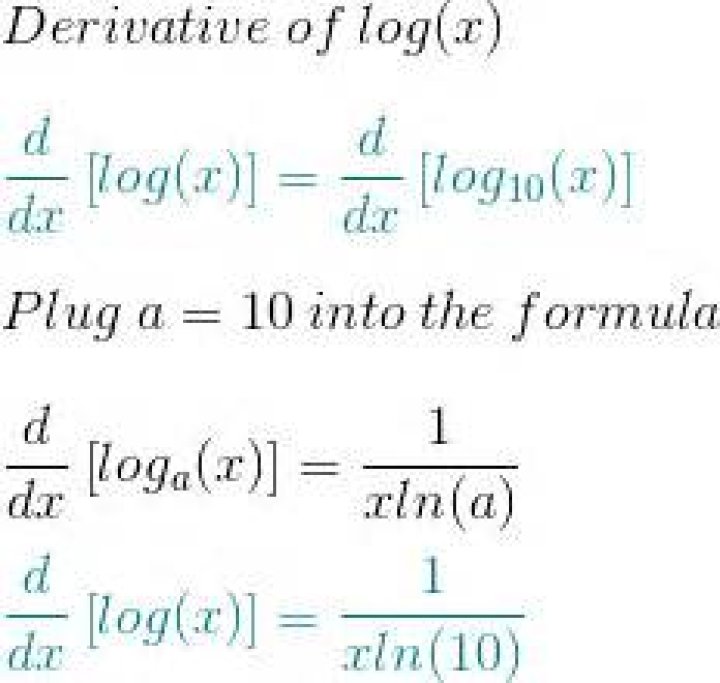
$\begingroup$The simple answer is that your derivative for $\log_{10}$ is incorrect. In fact $$\log_{10} x=\frac{\ln x} {\ln 10}$$ Thus you can see that the derivative is indeed smaller, being $\frac1{x\ln 10}$.
$\endgroup$6$\begingroup$There is a scaling factor. It turns out that$$\log_{10}'(x)=\frac1{\log(10)x}$$and not $\frac1x$, which is what you wrote.
More generally,$$\log_a'(x)=\frac1{\log(a)x}.$$
$\endgroup$4$\begingroup$I respectfully dispute Matt Samuel’s answer.
It is not wrong because it is fairly common for $\log$ to mean the natural logarithm as well as $\ln$. Just look at Wolfram|Alpha.
$\endgroup$2