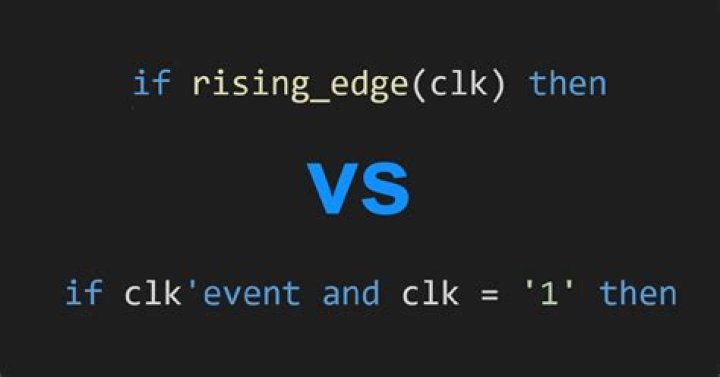

I had always used this for detecting a rising edge:
if (clk'event and clk='1') then
but this can also be used:
if rising_edge(clk) then
Reading this post, rising_edge(clk) is recommended, but there is also a comment indicating that rising_edge(clk) could lead to wrong behaviour.
I can't decide which one to choose for the future, going on with (clk'event and clk='1') or adopting rising_edge(clk).
Any real-world expereince on these two? Any preferences?
Thanks!
33 Answers
rising_edge is defined as:
FUNCTION rising_edge (SIGNAL s : std_ulogic) RETURN BOOLEAN IS BEGIN RETURN (s'EVENT AND (To_X01(s) = '1') AND (To_X01(s'LAST_VALUE) = '0')); END; FUNCTION To_X01 ( s : std_ulogic ) RETURN X01 IS BEGIN RETURN (cvt_to_x01(s)); END; CONSTANT cvt_to_x01 : logic_x01_table := ( 'X', -- 'U' 'X', -- 'X' '0', -- '0' '1', -- '1' 'X', -- 'Z' 'X', -- 'W' '0', -- 'L' '1', -- 'H' 'X' -- '-' ); If your clock only goes from 0 to 1, and from 1 to 0, then rising_edge will produce identical code. Otherwise, you can interpret the difference.
Personally, my clocks only go from 0 to 1 and vice versa. I find rising_edge(clk) to be more descriptive than the (clk'event and clk = '1') variant.
The linked comment is incorrect : 'L' to '1' will produce a rising edge.
In addition, if your clock signal transitions from 'H' to '1', rising_edge(clk) will (correctly) not trigger while (clk'event and clk = '1') (incorrectly) will.
Granted, that may look like a contrived example, but I have seen clock waveforms do that in real hardware, due to failures elsewhere.
Practical example:
Imagine that you are modelling something like an I2C bus (signals called SCL for clock and SDA for data), where the bus is tri-state and both nets have a weak pull-up. Your testbench should model the pull-up resistor on the PCB with a value of 'H'.
scl <= 'H'; -- Testbench resistor pullup Your I2C master or slave devices can drive the bus to '1' or '0' or leave it alone by assigning a 'Z'
Assigning a '1' to the SCL net will cause an event to happen, because the value of SCL changed.
If you have a line of code that relies on
(scl'event and scl = '1'), then you'll get a false trigger.If you have a line of code that relies on
rising_edge(scl), then you won't get a false trigger.
Continuing the example: you assign a '0' to SCL, then assign a 'Z'. The SCL net goes to '0', then back to 'H'.
Here, going from '1' to '0' isn't triggering either case, but going from '0' to 'H' will trigger a rising_edge(scl) condition (correct), but the (scl'event and scl = '1') case will miss it (incorrect).
General Recommenation:
Use rising_edge(clk) and falling_edge(clk) instead of clk'event for all code.