 $\begingroup$
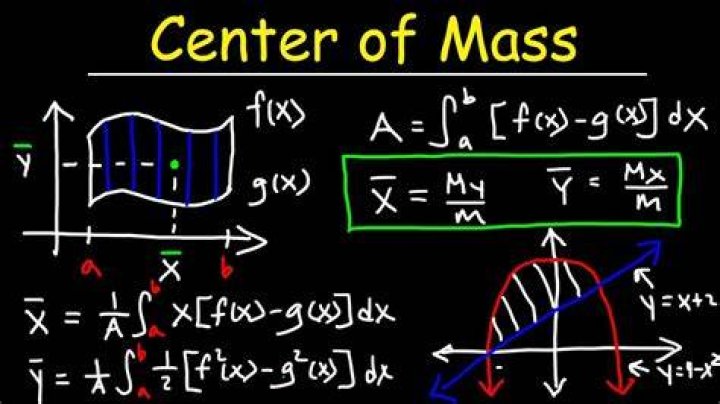
How would one find the center of mass of a circle? The center of mass of a rod is given by:
$$\frac{1}{M}\int^{L}_{0}\rho x dx$$
So, for a sphere, it would be an area integral, such as:
$$\frac{1}{M}\int^{?}_{?} \rho ? dA$$
The "?" mean I don't know what to put there.
This is an area integral, which means it needs to be taken over the two axises, correct?
$\endgroup$23 Answers
$\begingroup$When one knows, or can divine, the answer in advance there is often a co-ordinate system that makes the problem trivial. For the Center of Mass of a sphere, integrate from r = 0 to R, the two semi-spheres above and below the x-y plane. That then trivially becomes the integral from 0 to R of ( (2 * pi * r^2) - (2 * pi * r^2) ) * dr. Amazingly, this integral evaluates to the origin!
$\endgroup$3$\begingroup$Your first integral is correct. However, to find the center of mass of a sphere requires three integrals, one for each coordinate. Each of those integrals will look like the one you wrote down.
$$ \bar x = \frac{1}{M}\int_{S} \rho xdA $$ $$ \bar y = \frac{1}{M}\int_{S} \rho ydA $$ $$ \bar z = \frac{1}{M}\int_{S} \rho zdA $$
The limits of integration will have to cover the whole sphere so if you use spherical coordinates, which you should, the vertical angle will go from $0$ to $\pi$ and the azimuth will go from $0$ to $2\pi$. Of course, you'll have to convert $x,y$ and $z$ to whatever coordinate system you are using.
Let's set up $\bar x$ in spherical coordinates as an example. In spherical coordinates $$ dA = (Rd\theta)(R\sin \theta d\phi) = R^2\sin \theta d\theta d\phi $$
where I am using $\theta$ for the vertical angle and $\phi$ for the azimuth.
$$ \bar x = \frac{1}{M}\int_{S} \rho xdA = \frac{1}{M}\int_{0}^{2\pi}\int_{0}^{\pi}\rho xR^2\sin \theta d\theta d\phi = \frac{R^2}{M}\int_{0}^{2\pi}\int_{0}^{\pi}\rho x\sin \theta d\theta d\phi $$
Substituting $x = R\sin \theta \cos \phi$ gives us
$$ \bar x = \frac{R^2}{M}\int_{0}^{2\pi}\int_{0}^{\pi}\rho(R\sin \theta \cos \phi)\sin \theta d\theta d\phi = \frac{R^3}{M}\int_{0}^{2\pi}\int_{0}^{\pi}\rho \sin^2 \theta \cos \phi d\theta d\phi $$
$\endgroup$$\begingroup$For a disk (assuming is centered at $(x_c,y_c)=(0,0)$: the x coordinate would be:
$\frac{1}{M}\int^r_{-r}\int_{-\sqrt{r^2-x^2}}^{\sqrt{r^2-x^2}} \rho (x,y) x dx dy$, where $r$ is the radius
and the y coordinate would be:
$\frac{1}{M}\int^r_{-r}\int_{-\sqrt{r^2-x^2}}^{\sqrt{r^2-x^2}} \rho (x,y) ydx dy$, where $r$ is the radius
$\endgroup$7